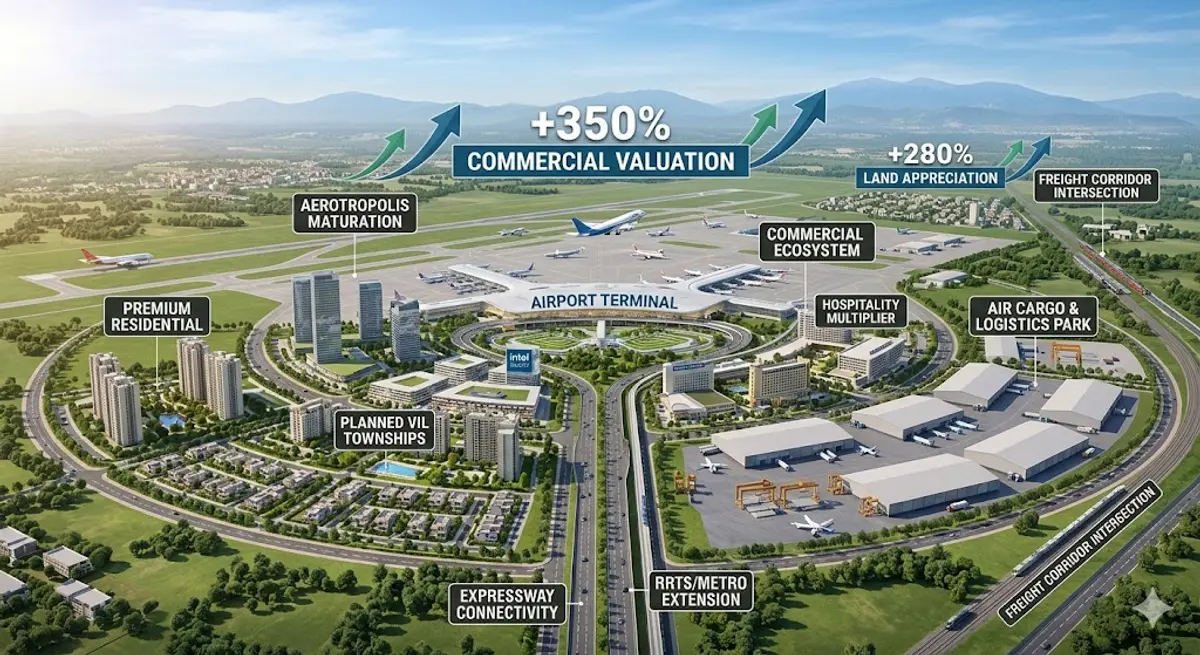
AIRPORT-DRIVEN REAL ESTATE GROWTH
AIRPORT-DRIVEN REAL ESTATE GROWTH
Airport-Driven Real Estate Growth: India's Most Powerful Infrastructure Investment Catalyst Of all infrastructure investments that drive real estate appreciation in India, airports are uniquely powerful. They do not merely improve connectivity — they redefine the economic identity of the zones around them, attract international business activity, generate high-income employment, and create a self-reinforcing demand cycle that can sustain property appreciation for decades.
India is in the middle of its most ambitious airport expansion in history. With 21 new greenfield airports planned by 2030, existing airports expanding capacity at record pace, and the UDAN regional connectivity scheme bringing air travel to tier-2 and tier-3 cities for the first time, the airport-driven real estate opportunity is spreading from established metros to entirely new geographies across the country.
At Intel Realty, we have tracked airport-driven real estate across India's major corridors for over a decade. From the transformation of Bengaluru's Devanahalli belt to the ongoing story of Navi Mumbai's Panvel zone to the early signals emerging from the Jewar corridor, this guide provides the data, the mechanism, and the framework investors need to identify and capture airport-driven appreciation before it fully matures.
INTEL REALTY RESEARCH
Land within 15 km of a major international airport in India has appreciated an average of 3.8 times more over 10 years than comparable land in the same region without airport adjacency, based on Intel Realty's analysis of 9 airport corridors tracked between 2012 and 2024.
Why Airports Are Uniquely Powerful Drivers of Real Estate Growth
Airports create real estate value through mechanisms that are both broader and more durable than those of any other single piece of infrastructure. Understanding these mechanisms helps investors identify not just where airport-driven appreciation occurs, but why it compounds over time in ways that expressway or metro appreciation alone cannot replicate.
The Aerotropolis Effect
Urban planners use the term 'aerotropolis' to describe the phenomenon where cities grow outward from airports rather than inward from traditional city centres. This is what has happened in Bengaluru, Hyderabad, and Delhi NCR — and what is now beginning to happen around Jewar, Navi Mumbai, and a dozen tier-2 cities receiving greenfield airports under UDAN. An aerotropolis is not just an airport with some hotels around it. It is a full urban system — commercial districts, logistics zones, hospitality clusters, residential townships, and retail corridors — that organises itself around the economic gravity of the airport.
High-Income Employment Concentration
International airports attract a specific category of employer: global corporations, aviation-linked businesses, export-oriented manufacturing, hospitality chains, and professional services that need air connectivity as a core business requirement. This employment profile is distinctively high-income relative to the typical industrial employment that expressways or freight corridors generate. High-income employment creates premium residential demand — demand for mid-to-luxury apartments, quality schools, and international retail — that drives faster and higher property appreciation per rupee of employment than standard industrial zones deliver.
Hospitality, Retail and Commercial Multiplier
Airports generate immediate, high-volume demand for hotels, restaurants, and retail — and this demand radiates outward from the terminal into the surrounding zone. A new international airport in a tier-2 city transforms the commercial real estate landscape within 15 to 20 km — attracting branded hotel chains, organised retail formats, and serviced apartment operators who would not previously have considered the location viable. This commercial demand creates a multiplier effect on surrounding land values that is particularly powerful in cities where organised retail and branded hospitality were previously absent.
Air Cargo and Logistics Premium
International airports with cargo handling capability create a logistics demand premium for surrounding land that compounds with the residential and commercial appreciation. Air cargo logistics — handling perishables, electronics, pharmaceuticals, and e-commerce express shipments — requires large land parcels with direct airside access or excellent highway connectivity to the cargo terminal. Land in this category commands the highest per-square-foot values in any airport zone and attracts the most stable, long-tenure institutional tenants.
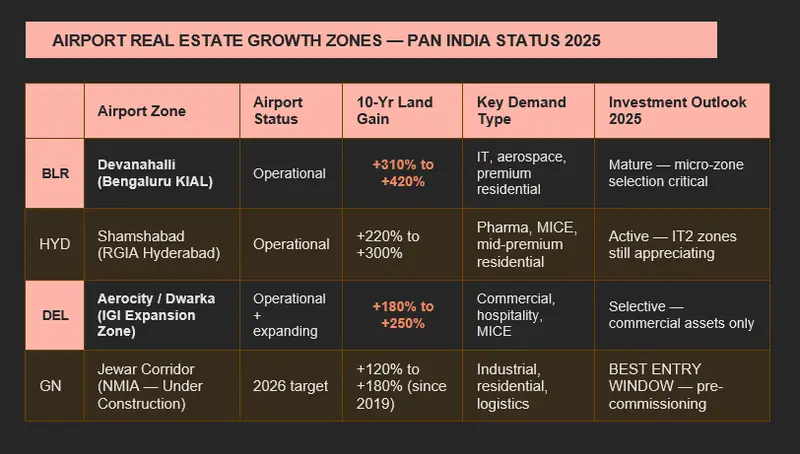
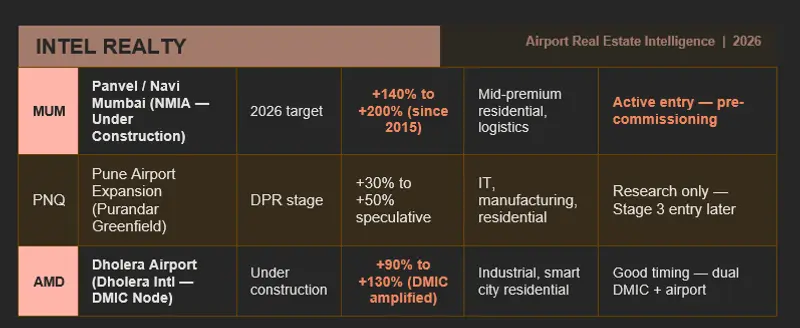
Airport Real Estate Growth Zones — Pan India Snapshot 2026
Airport-driven appreciation is playing out at different phases across India. Here is Intel Realty's current read on the most significant airport real estate corridors — rated by maturity, appreciation delivered, and current entry opportunity.
The Airport Appreciation Curve: When to Enter for Maximum Returns
Airport-driven real estate appreciation does not arrive in a single event. It accumulates across a multi-phase lifecycle that extends from announcement through full aerotropolis maturity — a timeline that can span 15 to 25 years. Understanding where you are on the curve determines what returns you can realistically expect and what risk you are taking.
PHASE 1 — ANNOUNCEMENT
Speculative surge of 15–30%. Very high execution risk. Entry only for land bankers with 10+ year horizons and strong credibility verification.
PHASE 2 — LAND ACQUISITION & DPR
Credibility building. 30–60% appreciation from baseline. Risk materially lower. Begin due diligence and site identification.
PHASE 3 — CONSTRUCTION VISIBLE
INTEL REALTY PREFERRED ENTRY. Execution risk near-zero. 40–80% residual upside to commissioning and 5-year post-commissioning maturation.
PHASE 4 — COMMISSIONING
Major re-rating event. 20–40% immediate uplift in most corridors. Post-commissioning entry captures maturation but misses the commissioning premium.
PHASE 5 — AEROTROPOLIS MATURATION
Long-tail appreciation as commercial and residential ecosystem builds. Entry still viable for commercial assets — residential largely priced in.
PHASE 6 — FULL AEROTROPOLIS
Mature market with stable yield-driven returns. Capital appreciation modest. Commercial institutional assets suitable for long-term income.
3 Case Studies: Airport-Driven Real Estate Growth Across India
01
Devanahalli — How Bengaluru's Airport Created a New City in a Decade
CLIENT VOICE
"I bought a residential plot in Devanahalli in 2008, two years after KIAL opened. Everyone thought it was too far from the city. But the airport was operational, IT companies were moving their campuses nearby, and the connectivity to central Bengaluru was improving. My plot has appreciated 9 times in 16 years." — Early Investor, Bengaluru
Kempegowda International Airport, which opened in Devanahalli in 2008, did not merely replace the old HAL Airport — it created an entirely new economic geography north of Bengaluru. What had been a rural belt of silk-farming villages and agricultural land within 15 km of the terminal has transformed into one of India's most active commercial and premium residential corridors, hosting IT campuses (Mphasis, Bosch, Wipro campus expansion), aerospace manufacturing (Hindustan Aeronautics Limited is headquartered nearby), a government-backed aerospace park, a flourishing hospitality cluster, and several luxury residential townships.
The appreciation timeline at Devanahalli is the clearest illustration of the airport curve in Indian real estate. Investors who entered in Phase 2 (DPR and land acquisition, 2004 to 2006) achieved returns of 800 to 1,200% over 15 years. Phase 3 entrants (visible construction, 2006 to 2008) achieved 500 to 700%. Phase 4 entrants at commissioning (2008 to 2012) achieved 250 to 400%. Each entry stage delivered exceptional returns in absolute terms — but the phase 2 to 3 window delivered the most on a risk-adjusted, annualised basis. Devanahalli is now in late Phase 5 — a mature corridor where micro-zone selection determines remaining upside.
KEY TAKEAWAYAirport-driven real estate in India can deliver 5x to 10x returns over a full cycle when entry timing is correctly aligned to the pre-commissioning phase. The Devanahalli story is the benchmark against which all other Indian airport corridors should be evaluated.
02
Navi Mumbai Airport Zone — 15 Years of Announcements, Now Finally a Buy Signal
CLIENT VOICE
"I tracked the Navi Mumbai Airport for 12 years without investing — every time I looked, the land acquisition was stalled or the timeline had slipped. In 2021, when actual runway construction became visible at Ulwe, I entered the Panvel-Kharghar belt at Rs. 7,200 per sq.ft. By 2025 the same location is at Rs. 11,500. This time the signal was real." — Patient Investor, Maharashtra
The Navi Mumbai International Airport is one of India's most studied cases of announcement-to-execution delay — and simultaneously, one of the clearest illustrations of why patient, execution-verified entry is the correct strategy for airport corridor investment. First announced in the early 2000s, the project faced 15+ years of delays driven by land acquisition disputes, environmental clearance complications, and funding issues. Investors who entered on announcement-stage signals in 2005 to 2008 absorbed years of stagnation and opportunity cost.
The correct entry signal arrived in 2019 to 2021 — when land acquisition crossed 85% completion, environmental clearance was received, and runway construction became physically visible at the Ulwe site. Intel Realty classified this as a Phase 3 entry opportunity at that point and recommended the Panvel-Kharghar-Taloja belt as the primary residential entry zone. Between 2021 and 2025, residential properties in this zone have appreciated 45 to 65% — with further upside remaining as the airport approaches its 2026 commissioning target and the aerotropolis maturation phase begins.
KEY TAKEAWAYThe Navi Mumbai Airport teaches one of the most important lessons in Indian real estate: announcement timing is not entry timing. Execution visibility is the signal. Entry at confirmed Phase 3 still captures the majority of remaining upside while eliminating years of execution risk.
03
Jewar NMIA — The Pre-Commissioning Window That Is Open Right Now
CLIENT VOICE
"Intel Realty identified the Jewar corridor in 2020 based on DFCCIL alignment maps and Yamuna Authority land acquisition data. The airport was real and fully funded. The Yamuna Expressway was already serving as the connector. We entered residential and industrial plots between 2020 and 2022. Appreciation to date: 68 to 85%. The commissioning is still ahead of us." — Portfolio Investor, NCR
The Noida International Airport at Jewar — being developed by Zurich Airport International with committed central and state government funding — represents the most significant pre-commissioning airport investment opportunity in India today. The airport has cleared land acquisition, environmental approvals, and civil work commencement — placing it firmly in Phase 3. The commissioning target of late 2025 to early 2026 means the commissioning premium has not yet been captured.
What makes the Jewar corridor distinctive is the compound catalyst structure: the airport sits at the intersection of the Yamuna Expressway, the proposed WDFC connection, and the planned RRTS extension from Delhi — creating a multi-infrastructure convergence that amplifies appreciation beyond what any single catalyst could deliver. Industrial, residential, and commercial demand are all building simultaneously. Intel Realty's clients who entered in 2020 to 2022 have seen 68 to 85% appreciation and are still positioned ahead of the commissioning uplift and early aerotropolis maturation phases.
KEY TAKEAWAYMulti-infrastructure convergence — where an airport, expressway, freight corridor, and rapid transit all intersect — creates the most powerful real estate appreciation environment in India. The Jewar corridor is the clearest current example of this convergence.
How to Evaluate an Airport Real Estate Investment Opportunity
Airport corridor investment rewards disciplined, execution-verified entry. Here is Intel Realty's eight-point framework for evaluating any airport-driven real estate opportunity across India:
Verify execution stage: Confirm whether the airport is at announcement, DPR, land acquisition, construction, or operational phase. Only enter at Phase 3 (construction visible) or later — unless you have a 10+ year horizon and exceptional credibility evidence.
Check land acquisition completion: India's biggest airport delay driver is land acquisition. Any project below 70% land acquisition completion carries meaningful execution risk. Above 85% is the Intel Realty minimum for Phase 3 classification.
Confirm funding structure: Government-funded or PPP airports with committed private equity (Zurich Airport, Adani Group, GMR) have substantially higher execution credibility than purely government-announced projects without private sector commitment.
Assess multi-infrastructure convergence: Airports intersecting with expressways, freight corridors, metro extensions, or RRTS corridors deliver compounding appreciation that single-catalyst airport zones cannot replicate. Jewar is the clearest current example.
Map the 15-km catchment: Airport real estate appreciation concentrates within 15 km of the terminal. Beyond 20 km, the measurable premium diminishes significantly. Within the 15 km zone, prioritise areas with planned connecting road and transit infrastructure.
Identify the primary demand character: High-income employment airports (IT/aerospace) support premium residential. Cargo-heavy airports support logistics land. Mixed-use airports support a blend. Asset type should match the airport's primary economic character.
Evaluate competing supply: In mature corridors like Devanahalli, supply surge has occurred and micro-zone selection is critical. In early-stage corridors like Jewar, supply is still below demand — creating a more favourable entry environment.
Verify RERA registration: Airport announcement zones attract aggressive developer launches before execution is certain. Independent RERA verification and HRERA/MahaRERA project status checking are non-negotiable before any booking commitment.
INTEL REALTY STANDARD
We classify airport corridors by execution phase before making any recommendation. Phase 3 (construction visible) with 85%+ land acquisition is our minimum entry threshold. Multi-infrastructure convergence zones receive our highest conviction rating. We verify all execution signals independently before any client capital is committed.
FREQUENTLY ASKED QUESTIONS
FAQ: Airport-Driven Real Estate Growth in India
Q1—How do airports drive real estate growth in India?
Airports drive real estate growth through four compounding mechanisms: the aerotropolis effect (cities reorganise around airport gravity, attracting commercial and residential development); high-income employment concentration (global businesses, aviation-linked industries, and export manufacturers create premium residential demand); hospitality and commercial multiplier (international airports attract branded hotels, organised retail, and serviced apartments that transform commercial land values in previously under-served zones); and air cargo logistics premium (cargo-capable airports create institutional demand for logistics land near the terminal). Together these mechanisms sustain appreciation across a 15 to 25 year development cycle — making airport corridors uniquely durable real estate investments.
Q2—Which airport zones in India offer the best real estate investment in 2025?
Based on Intel Realty's 2025 zone assessment, the best current entry opportunities are: the Jewar-NMIA corridor (Phase 3, construction visible, commissioning 2025 to 2026 — best pre-commissioning window currently open); Navi Mumbai Airport zone / Panvel-Kharghar belt (Phase 3 to 4, pre-commissioning residential still available); and the Dholera Airport zone (dual DMIC + airport catalyst, good Phase 2 to 3 entry). Devanahalli (Bengaluru) and Shamshabad (Hyderabad) are mature corridors — recommended for micro-zone commercial selection only. Purandar (Pune) remains at DPR stage — research only.
Q3—What is the best time to invest in property near a new airport in India?
Intel Realty's research consistently shows that Phase 3 — when airport construction is physically visible and land acquisition is 85% or more complete — offers the best risk-adjusted entry point. This phase typically arrives 18 to 36 months before commissioning. It captures the commissioning premium (typically 20 to 40% appreciation), the first-year operational re-rating, and the early aerotropolis maturation phase — all three of the largest remaining appreciation phases — while carrying minimal execution risk. Phase 2 entry delivers higher absolute returns for investors with 7 to 10 year horizons who can verify strong execution credibility signals.
Q4—Does an airport announcement alone justify paying a property premium?
No — and this is the most important caution for Indian airport corridor investment. Airport announcements in India have historically been followed by delays of 5 to 20 years in many cases. The Navi Mumbai Airport was announced in the early 2000s and did not begin meaningful construction until 2019. Buyers who paid airport adjacency premiums in 2005 to 2008 absorbed a decade of stagnation. An airport announcement should trigger research and site identification — not investment commitment. The correct entry signal is Phase 3: construction visibly underway, land acquisition 85%+ complete, private sector funding committed, and connecting infrastructure confirmed.
Q5—How does Intel Realty identify airport investment opportunities before the market does?
Intel Realty tracks all major airport projects through a combination of AAI (Airports Authority of India) project status monitoring, Ministry of Civil Aviation tender awards, state government land acquisition notifications from district collector records, environmental clearance status from MoEFCC, and private sector operator (GMR, Adani, Zurich Airport) investment commitments. We apply our six-phase execution classification to every corridor monthly and update entry recommendations accordingly. When a corridor moves from Phase 2 to Phase 3 — our minimum investment threshold — we initiate active due diligence and alert clients with suitable investment profiles before the transition receives mainstream media coverage.