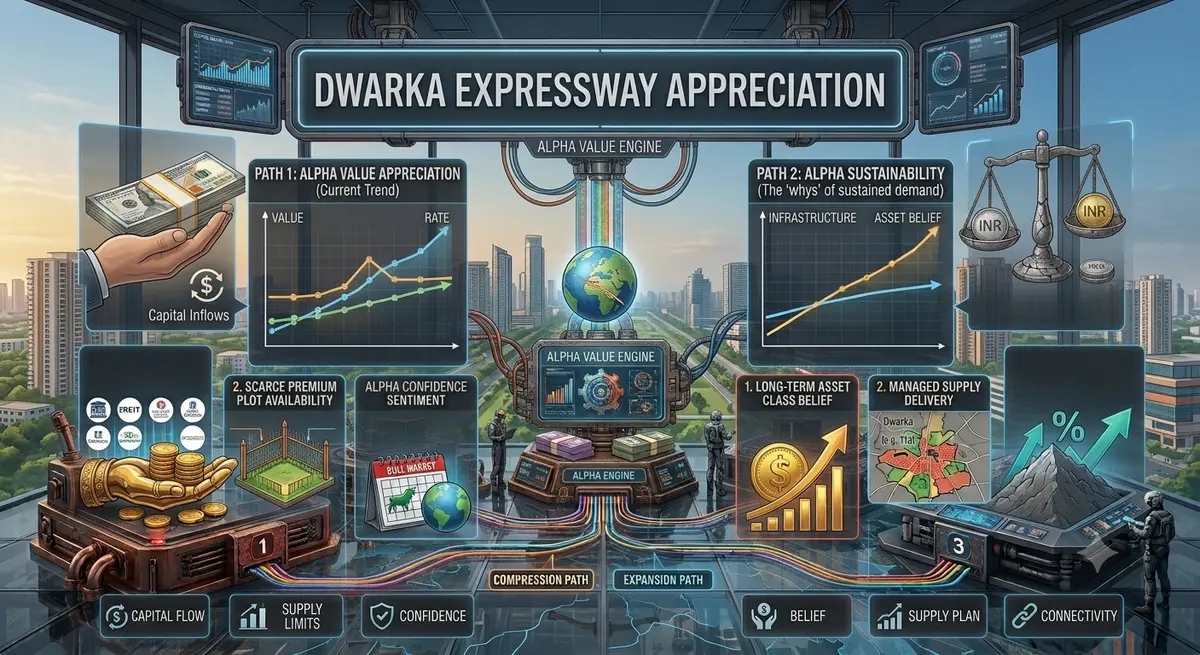
Dwarka Expressway Circle Rate Hike: Why Demand is Surging
The Dwarka Expressway Alpha: Why a 66% Circle Rate Hike Hasn't Slowed Down Demand
The Gurgaon real estate market has long stood as the definitive powerhouse of the Delhi-NCR property landscape. However, the rollout of the 2026 collector rate structural revision has sent shockwaves through the regional infrastructure ecosystem. The Haryana state government recently pushed through one of its sharpest circle rate corrections in history, increasing property valuation benchmarks by 15% to 75% across the city's primary development corridors.
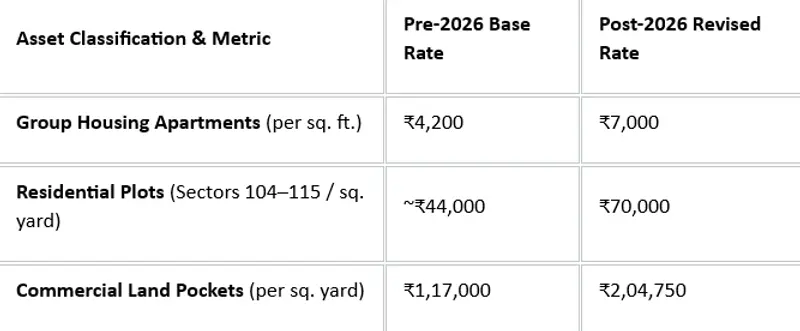
Among these adjustments, the most striking is the massive 66% circle rate hike implemented across the high-velocity micro-markets of the Dwarka Expressway, specifically impacting the critical residential belts of Sectors 104 to 115.
Under traditional economic principles, a sudden fiscal intervention of this magnitude—which directly increases stamp duty obligations and upfront cash outflows—should trigger a temporary cooling-off phase or a pullback in consumer velocity. Yet, the ground reality across the expressway tells a completely different story.
Transaction pipelines remain highly robust, corporate developer launches are heavily oversubscribed, and site visits continue to peak. This unique phenomenon—the "Dwarka Expressway Alpha"—demonstrates that the corridor has fundamentally broken away from conventional price-elasticity limitations.
Decoding the Financial Impact of the 2026 Circle Rate Hike
To comprehend why market demand remains entirely unfazed, it is vital to analyze the exact shift in numbers. Circle rates (or collector rates) serve as the absolute state-mandated minimum valuation at which an asset can be legally registered during a property transfer.
Below is how the 2026 structural reset has recalibrated values along the Dwarka Expressway corridor:
In the state of Haryana, stamp duty and registration outlays are computed strictly on whichever value is higher between the declared market transaction price and the official circle rate.
Before this update, a glaring disparity existed between the low circle rates and actual market transactional values, where premium residential units frequently traded between ₹12,000 and ₹18,000 per square foot.
Expert Insight: This 66% hike does not artificially inflate the underlying property value; rather, it rapidly compresses the historic gap between state metrics and actual ground valuations. The ultimate acquisition price increases marginally strictly on account of higher stamp duty fees, but the intrinsic demand for the location remains unchanged.
The Three Core Pillars Sustaining the Dwarka Expressway Demand
The resilience of the Dwarka Expressway real estate market against fiscal tightening rests upon three powerful structural pillars:
1. Absolute Infrastructure Maturity & Global Connectivity
The primary engine driving the uninterrupted absorption of luxury apartments on the Dwarka Expressway is the physical operationalization of the expressway itself. This state-of-the-art corridor provides rapid, multi-lane connectivity linking Gurgaon seamlessly with West/South Delhi and the Indira Gandhi International Airport (IGI).
Coupled with immediate access to the newly minted International Convention and Expo Centre (IICC) in Yashobhoomi and the multi-billion dollar Global City masterplan, the corridor has transitioned from a speculative "future market" into a mature, high-utility destination. Homebuyers are willing to absorb elevated registration fees because the tangible daily lifestyle utility and reduction in commute times are unmatched across the NCR.
2. Heightened Institutional Transparency and Capital Inflow
For institutional private equity funds, premium domestic developers (such as DLF, Sobha, and Signature Global), and global Non-Resident Indians (NRIs), this circle rate increase is viewed as a highly positive regulatory evolution. Historically, wide discrepancies between circle rates and real sale prices introduced transaction friction and valuation opacity.
By raising the floor rate closer to realistic market standards, the state has institutionalized transparency. Clean institutional wealth and global NRI investors demand highly transparent, compliant ecosystems. The 2026 revision acts as an official endorsement of the market's long-term maturity, boosting buyer confidence.
3. Mitigation of Income Tax Scrutiny Risks
An overlooked benefit of this rate alignment is the protection it provides buyers under Section 56(2)(x) of the Income Tax Act. When a transaction occurs in a zone where the circle rate lags drastically behind market reality, it frequently triggers aggressive income tax evaluations regarding artificial undervaluation. Bringing the official collector rates closer to real-world asset pricing minimizes long-term tax litigation risks for high-net-worth individuals (HNIs).
The Evolving Buyer Profile: End-Users and Global Capital
The customer base along the expressway has experienced a profound demographic shift. The highly leveraged, short-term speculators who dominated the area a decade ago have been entirely replaced by highly resilient capital allocators:
- Affluent Corporate End-Users: Senior corporate executives, tech founders, and double-income professionals working out of the premium commercial hubs of Cyber City and Golf Course Road. This segment treats a home on the Dwarka Expressway as a long-term quality-of-life upgrade featuring vast floor plates, home automation, and world-class clubhouse amenities.
- Resilient NRI Wealth: Backed by favorable currency dynamics and robust regulatory structures under RERA, global investors from the US, UK, Singapore, and the Middle East are aggressively looking to buy into the Gurgaon real estate market. The transparent structural pricing changes validate their decision to allocate capital to blue-chip Indian infrastructure nodes.
Strategic Investment Playbook for the Post-Hike Market
To capitalize on the current market realities, investors should deploy a systematic approach:
- Re-Model Cash Flows Early: Do not rely on historical cost templates. Ensure that your transaction spreadsheets explicitly account for the updated stamp duty calculated against the ₹7,000 per sq. ft. baseline for apartments or up to ₹70,000 per sq. yard for residential plots.
- Exploit the New Gurgaon Pricing Cushion: While Sectors 104–115 absorbed the direct impact of the 66% shift, they still possess a massive pricing advantage compared to established micro-markets like Golf Course Road, where premium luxury developments feature circle rates exceeding ₹39,000 per sq. ft. The long-term capital appreciation runway remains highly favorable along the expressway.
- Prioritize Execution Track Records: In a transparent, high-value ecosystem, execution speed trumps speculative promises. Focus your portfolio allocation strictly on Tier-1 developers who display pristine corporate governance and independent construction liquidity lines.
The 2026 circle rate hike along the Dwarka Expressway is not a market barrier; it is the ultimate validation of the corridor's blue-chip maturity. By stepping in to align official benchmarks with ground realities, the state government has officially signaled that the Dwarka Expressway is no longer an emerging asset class—it is a secure, institutionalized, and premier real estate destination.
FAQ Section
Q1: How exactly does the 2026 Gurgaon circle rate hike impact the total cost of my property purchase?
A: The circle rate hike directly increases the stamp duty and registration charges you pay to the government. Because stamp duty is calculated on whichever value is higher between the market price and the circle rate, the 66% increase along the Dwarka Expressway raises the minimum tax baseline for your property registry. It does not, however, mean that the base price charged by the developer automatically climbs by 66%.
Q2: Why hasn't property demand on the Dwarka Expressway slowed down after this major rate increase?
A: Demand remains highly resilient because the underlying value proposition of the corridor is driven by tangible infrastructure maturity, such as seamless connectivity to South/West Delhi and the IGI Airport. Furthermore, actual market trading prices were already higher than the old circle rates, meaning the hike simply aligns official numbers with ground realities without shocking structural market values.
Q3: What are the newly revised circle rates for apartments and plots on the Dwarka Expressway?
A: For the 2026–27 fiscal period, group housing apartment circle rates have been increased from a baseline of ₹4,200 per sq. ft. to ₹7,000 per sq. ft. Residential plots across high-growth sectors (104 to 115) have moved up to approximately ₹66,125 to ₹70,000 per square yard, reflecting the massive infrastructure upscaling of the corridor.
Q4: Does a higher circle rate offer any underlying benefits to property buyers and NRIs?
A: Yes. A higher circle rate significantly narrows the valuation gap between official state pricing and actual market trading prices, minimizing the injection of unaccounted capital and maximizing marketplace transparency. Additionally, it heavily reduces the risk of income tax audits and penalties under Section 56(2)(x) of the Income Tax Act, which often target properties suspected of being undervalued at registration.
Q5: Will this step-up in Gurgaon collector rates lead to a drop in property prices?
A: No, a reduction in property prices is highly unlikely. Historically, aligning circle rates with market valuations acts as a trust-building mechanism for institutional investors and end-users alike. Coupled with rising raw material and construction costs (now hovering around ₹2,100 per sq. ft.), the structural pricing floor for premium real estate in Gurgaon is expected to remain strongly anchored and on an upward trajectory.