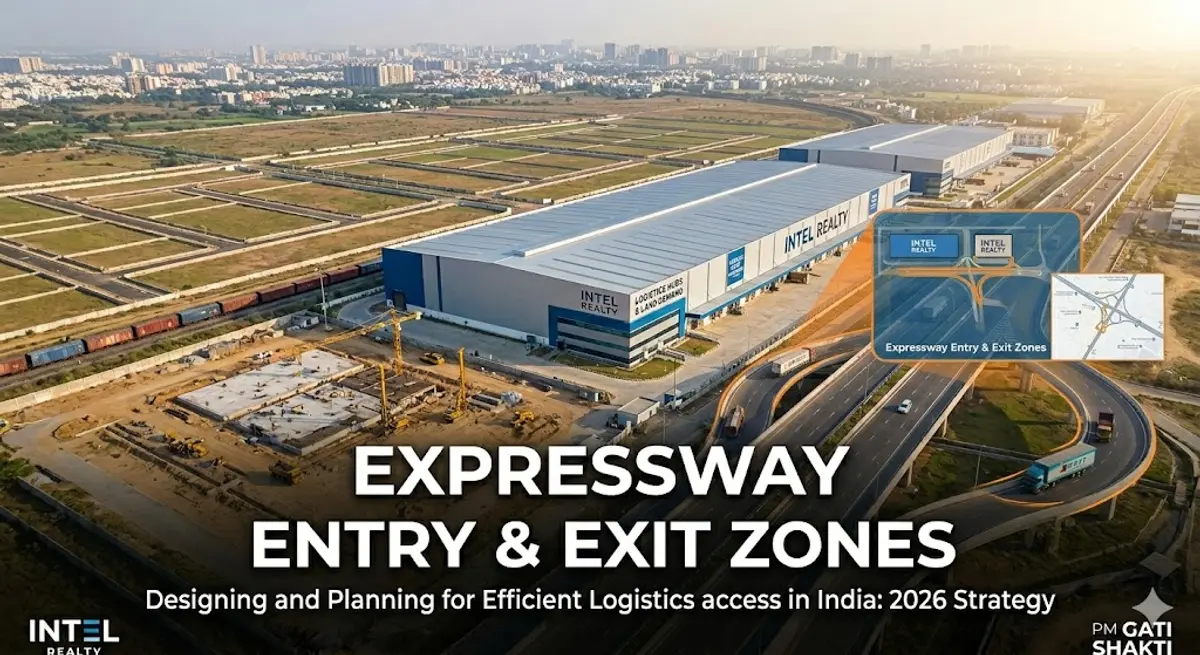
EXPRESSWAY ENTRY & EXIT ZONES
Expressway Entry and Exit Zones: The Real Driver of Highway Property Returns in India
Most property buyers think about expressways in terms of proximity — how close is the plot to the highway? But proximity to a high-speed expressway is largely irrelevant for real estate value if the nearest entry and exit point is 10 kilometres away. The decisive variable is not distance to the expressway. It is distance to the interchange — the entry and exit zone where vehicles actually join and leave the highway.
This distinction — between expressway proximity and interchange proximity — is one of the most commonly misunderstood concepts in Indian real estate investment. Developers routinely market properties as 'expressway adjacent' without disclosing that the nearest interchange is well beyond reasonable access distance. Buyers pay premiums for connectivity they will never experience in daily life.
At Intel Realty, interchange zone analysis is a foundational element of every expressway-linked investment evaluation we conduct across India. This guide explains why entry and exit zones matter, how they create real estate value, what the data shows about appreciation gradients, and how investors can map interchange proximity before committing capital to any expressway corridor.
INTEL REALTY RESEARCH
Across 15 major expressway corridors studied in India between 2005 and 2024, properties within 2 km of an interchange appreciated an average of 3.4 times more than properties in the same corridor that were more than 7 km from the nearest interchange — despite being along the same highway.
Why Expressway Entry and Exit Zones Create Real Estate Value
To understand why interchanges drive real estate appreciation, it helps to think about what an interchange actually does. A high-speed expressway is inaccessible except at designated entry and exit points. The interchange is the gateway — the location where the expressway's speed and connectivity advantage becomes usable for the surrounding land. Everything within a reasonable radius of an interchange inherits the connectivity benefit. Everything outside that radius is adjacent to an expressway it cannot access.
Industrial and Logistics Demand Concentration
Manufacturing and logistics operators locate near interchanges because their business depends on truck movement. Container trucks, delivery vehicles, and raw material carriers need direct access to the expressway network — and they need it at scale, multiple times per day. A warehouse 3 km from an interchange operates with fundamentally different logistics economics than one 12 km away, even if both are 'on the expressway corridor'. This operational requirement concentrates industrial and logistics land demand within the interchange catchment, driving sustained land appreciation that mid-corridor locations cannot replicate.
Commercial and Retail Gravity
Interchanges are natural commercial gravity points. Fuel stations, dhabas, highway restaurants, hotels, and petrol pumps cluster near interchanges because that is where traffic decelerates, decision-making happens, and spending occurs. Over time, this commercial seeding around interchanges attracts organised retail, branded hospitality, and eventually mixed-use commercial development. The commercial ecosystem that forms around mature interchanges — visible on highways like the Mumbai-Pune Expressway at Khopoli or the Yamuna Expressway at Greater Noida — sustains commercial real estate demand that is genuinely connected to the expressway's economic activity.
Residential Commuter Accessibility
For residential investors, interchange proximity determines whether the expressway is a daily commute solution or merely a weekend travel improvement. A resident who lives 2 km from an interchange can enter the expressway in under 5 minutes — making the expressway a genuine daily commute option for employment centres at the other end. A resident who lives 15 km from the nearest interchange must first navigate congested local roads before reaching the expressway — cancelling much of the time benefit that made the expressway attractive in the first place. This functional commutability is what separates residential markets that appreciate durably near expressways from those that appreciate on announcement and then stagnate.
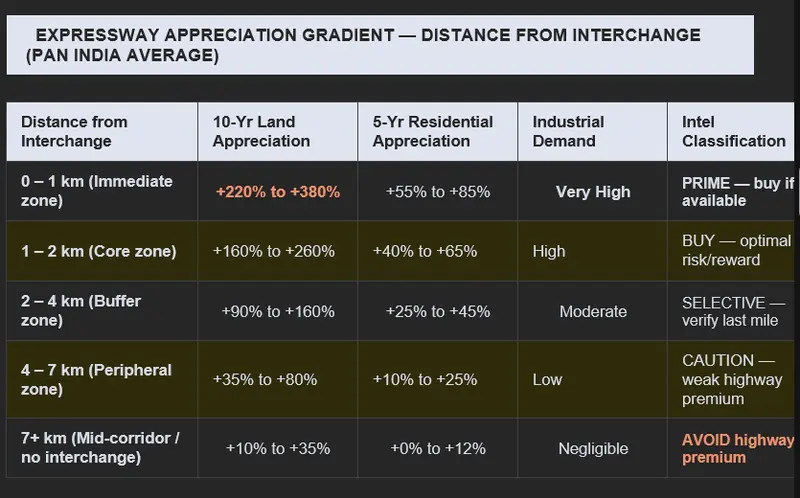
The Expressway Appreciation Gradient: Distance From Interchange Determines Returns
Intel Realty's pan-India research has mapped the appreciation gradient at different distances from expressway interchanges. The pattern is consistent across every major corridor studied — from the Yamuna Expressway to the Mumbai-Pune Expressway to the Hyderabad ORR to the Delhi-Meerut Expressway.
Types of Expressway Interchanges — Not All Entry Points Are Equal
Knowing that interchange proximity matters is the starting point. The next level of analysis is understanding that not all interchanges are equal. The type of interchange — its connectivity, its catchment, and its economic character — significantly determines which end of the appreciation range a nearby investment captures.
Major City-Boundary Interchanges
The highest-value interchange zones are those at the entry and exit points of major cities — where the expressway meets the urban road network. These interchanges serve maximum daily traffic volume, attract the densest commercial clustering, and generate the strongest residential commuter demand. The Noida-Greater Noida Expressway entry near the DND Flyway, the Mumbai end of the Mumbai-Pune Expressway, and the Bengaluru entry of the Bengaluru-Mysuru Expressway are examples of city-boundary interchanges that have generated the highest absolute appreciation per square foot in their respective corridors.
Industrial Node Interchanges
Industrial node interchanges serve planned industrial parks, Special Economic Zones, or DMIC nodes along the expressway alignment. These interchanges generate their real estate value through industrial land demand rather than residential demand — attracting manufacturing and logistics occupiers who need expressway freight access. The Manesar interchange on NH-48, the Palanpur interchange on the WDFC-parallel highway, and the Krishnapatnam interchange on the CBIC corridor are examples of industrial node interchanges with strong, demand-driven land appreciation profiles.
Mid-Route Commercial Interchanges
Mid-route interchanges serve district headquarters, market towns, or tourism nodes along the expressway alignment. These interchanges generate commercial and hospitality demand rather than industrial demand — attracting fuel stations, hotels, food courts, and convenience retail. Real estate appreciation near mid-route interchanges is driven by commercial land demand rather than residential or industrial, and the investment profile differs accordingly. For investors, mid-route commercial interchange zones offer commercial plot opportunities at lower entry prices than city-boundary interchange zones.
Future Planned Interchanges
Many expressways have planned but not yet operational interchanges — shown in NHAI alignment maps and DPRs but not yet constructed. These future interchanges represent early-entry opportunities for investors who can read the official planning documents, verify that the interchange is funded and under construction, and position in the surrounding land before the interchange opens and triggers the immediate price re-rating. This requires more due diligence but offers the highest appreciation potential for investors with 4 to 8 year hold horizons.
3 Case Studies: Interchange Zone vs Mid-Corridor — The Returns Tell the Story
01
Yamuna Expressway: Interchange Zone vs Mid-Corridor — A 4x Difference
CLIENT VOICE
"Two of us bought on the Yamuna Expressway at the same time with the same budget. My friend bought near the Mathura interchange — close to the commercial hub and industrial node. I bought mid-corridor, drawn in by the developer's marketing. After 8 years, he has 220% appreciation. I have 55%. Same expressway, same entry year, completely different outcomes." — Property Investor, NCR
The Yamuna Expressway — 165 km connecting Greater Noida to Agra — provides one of India's starkest natural experiments in interchange zone versus mid-corridor appreciation. Investors who purchased land or plotted development within 2 to 3 km of the Greater Noida interchange (the expressway's start) and the Agra interchange (the expressway's end) captured appreciation of 180 to 260% between 2012 and 2022. Investors who purchased mid-corridor — between the Mathura and Aligarh interchanges without proximity to either — saw appreciation of 40 to 70% over the same period.
The divergence is explained by functional access. The Greater Noida interchange attracts e-commerce fulfilment centres, light manufacturing, and residential demand from NCR workers. The Agra interchange serves tourism, heritage hospitality, and regional commerce. Mid-corridor zones without a functioning interchange serve primarily local village traffic — the expressway passes by but provides no meaningful economic uplift. Developers who marketed mid-corridor plots as 'Yamuna Expressway facing' were technically accurate and practically misleading.
KEY TAKEAWAYThe expressway's address is not the investment. The interchange's economic catchment is. Always verify which interchange zone your investment falls within — and what demand that specific interchange serves.
02
Mumbai-Pune Expressway: Khopoli Interchange — Tourism Demand Drives 175% in a Decade
CLIENT VOICE
"I bought near the Khopoli exit because I looked at where people actually stopped — not where the highway was closest to my plot. Tourism, weekenders, and industrial workers from the nearby Khopoli industrial estate all converge at this interchange. 10 years later, I have 175% appreciation. My neighbour bought mid-expressway with no exit for 8 km in either direction. He has 62%." — Long-term Investor, Maharashtra
The Khopoli interchange on the Mumbai-Pune Expressway serves a dual-demand profile — tourism (Lonavala is within 15 km, and the interchange serves the Khalapur-Khopoli industrial belt) and leisure hospitality from Mumbai weekenders. Land and plotted development within 2 km of the Khopoli interchange appreciated 150 to 200% between 2012 and 2022 — driven by genuine commercial and residential demand from both industrial workers and weekend visitors.
Mid-expressway properties between the Khalapur and Lonavala interchanges — where the highway passes through scenic ghat terrain but offers no exit within 10 to 12 km — appreciated 50 to 70% over the same period. The scenic view from the plot window did not substitute for interchange accessibility. Intel Realty's field analysis of this corridor in 2014 clearly identified Khopoli as a priority entry zone based on interchange traffic volume, industrial employment density, and tourism catchment — all publicly available data that most retail investors never examine.
KEY TAKEAWAYTourism-serving interchanges create durable commercial and residential demand that compounds across multiple market cycles. Hospitality, retail, and weekend-home demand sustains interchange appreciation even during periods when primary residential markets slow.
03
Delhi-Meerut Expressway: The Future Interchange Play — Dasna Entry Zone
CLIENT VOICE
"Intel Realty analysed the NHAI alignment maps for the Delhi-Meerut Expressway in 2019 and identified the Dasna interchange as the zone with the strongest future demand case. The interchange was under construction, not yet open. I entered plotted development at Rs. 1,900 per sq.ft. By 2024, with the interchange operational and multiple industrial units established nearby, the market rate is Rs. 3,600 per sq.ft — 89% in 5 years." — Plot Investor, Ghaziabad
The Dasna interchange on the Delhi-Meerut Expressway demonstrates the future planned interchange entry strategy in practice. Intel Realty's analysis of NHAI's detailed alignment maps in 2018 identified Dasna as the interchange with the strongest demand potential on the corridor — serving Ghaziabad's industrial periphery, connecting to the Hapur bypass, and positioned to attract e-commerce fulfilment demand given its proximity to the Delhi logistics consumption market.
Entry in 2019 — when the interchange was funded and under construction but not yet open — captured both the pre-opening appreciation (as market awareness of the interchange grew) and the post-opening appreciation (as industrial tenants and commuter residential buyers priced in the functional connectivity). The full 89% return over 5 years is split roughly 40% pre-opening and 49% post-opening — illustrating the value of the planned interchange entry strategy versus waiting for commissioning.
KEY TAKEAWAYNHAI alignment maps and DPR documents identify planned interchanges years before they open. Investors who verify funding, construction progress, and economic catchment of planned interchanges — and enter before opening — capture both the pre-opening and post-opening appreciation phases.
How to Map Interchange Zones Before You Invest: A Practical Guide
Every piece of information you need to identify and evaluate expressway interchange zones is publicly available. Here is Intel Realty's step-by-step process:
STEP 1 — FIND THE INTERCHANGES
Download the Detailed Project Report (DPR) for the expressway from NHAI's official website. DPRs show all planned, operational, and future interchanges with chainage (kilometre markers) and connecting road details.
STEP 2 — MAP YOUR PROPERTY
Using Google Maps or NHAI's alignment overlay (available on the NHAI portal), measure the actual road distance from your prospective plot to the nearest interchange exit ramp — not straight-line distance. Road distance determines true travel time.
STEP 3 — CLASSIFY THE INTERCHANGE
Identify whether the interchange is a city-boundary, industrial node, commercial mid-route, or future planned type. Each type implies different demand character and different asset class recommendations.
STEP 4 — CHECK INTERCHANGE STATUS
Verify the interchange's operational status. An operational interchange delivers present demand. A planned interchange at Stage 3 or 4 (funded, under construction) delivers pre-opening appreciation opportunity. A Stage 1 interchange (announced only) carries significant delay risk.
STEP 5 — ASSESS TRAFFIC VOLUME
NHAI publishes toll plaza traffic count data for operational interchanges. High PCU (passenger car unit) counts confirm genuine demand. Low counts in a mature corridor are a warning signal that the interchange is not generating the commercial gravity you are pricing for.
STEP 6 — VERIFY LAST MILE ACCESS
Confirm that the road connecting your property to the interchange is paved, maintained, and appropriate for the traffic volume it will carry. An interchange 3 km away on a mud track is functionally worse than an interchange 6 km away on a good district road.
FAQ: Expressway Entry and Exit Zones — Real Estate Investment India
Q1—What is an expressway entry and exit zone, and why does it matter for property investment?
An expressway entry and exit zone — or interchange zone — is the area surrounding the on-ramp and off-ramp junction where vehicles join and leave a high-speed expressway. It matters for property investment because an expressway is only accessible at these designated points. Properties within 2 to 4 km of an interchange have genuine highway access — meaning the expressway's speed and connectivity advantage is usable on a daily basis. Properties more than 7 km from the nearest interchange have no meaningful highway access despite being 'on the expressway corridor'. Intel Realty's research shows that interchange-zone properties appreciate 3.4 times more than mid-corridor properties over 10 years — driven entirely by this functional access differential.
Q2—How do I find the nearest interchange to a property I am considering in India?
Download the NHAI Detailed Project Report (DPR) for the relevant expressway from the NHAI official website — these documents show every planned and operational interchange with kilometre markings and connecting road details. Then use Google Maps to measure actual road distance from the property to the nearest interchange exit ramp. Compare the two to verify that the expressway-adjacent address in the developer's brochure translates into functional interchange access. Intel Realty's research team does this analysis for every expressway corridor recommendation we make across India.
Q3—Which types of interchanges create the best real estate investment opportunities?
City-boundary interchanges deliver the highest absolute appreciation — serving maximum traffic volume and anchoring both residential and commercial demand. Industrial node interchanges deliver the strongest industrial land appreciation over a 7 to 12 year hold. Mid-route commercial interchanges deliver solid commercial and hospitality land returns at lower entry prices. Future planned interchanges at Stage 3 or 4 (funded and under construction) offer the best pre-opening appreciation opportunity for investors with 4 to 8 year horizons. The type of interchange determines the appropriate asset class — and mismatching asset to interchange type is the single most common cause of expressway investment underperformance.
Q4—What is the maximum distance from an interchange that still captures a meaningful real estate premium?
Based on Intel Realty's pan-India corridor research, the meaningful highway premium for real estate is reliably present up to 4 km from an interchange. Between 4 and 7 km, the premium diminishes to 30 to 80% above the regional benchmark — still positive but much weaker. Beyond 7 km, properties appreciate at rates that are statistically indistinguishable from the broader regional market average — meaning there is effectively no highway premium left to capture. For industrial and logistics land, the cutoff is tighter — most industrial operators will not locate more than 3 km from an interchange due to daily truck movement requirements.
Q5—How does Intel Realty use interchange zone analysis in its investment recommendations?
Intel Realty maps every major expressway corridor in India against NHAI alignment data to identify all operational and planned interchange zones. For each corridor under evaluation, we classify each interchange by type (city-boundary, industrial node, commercial mid-route, or future planned) and assess its operational status, traffic volume from NHAI toll data, economic catchment from district economic profiles, and ancillary infrastructure quality. We then recommend only those properties within our verified interchange catchment zones — typically 1 to 4 km from operational or Stage 3+ planned interchanges. Properties marketed as 'expressway adjacent' that fall outside these catchments receive a no-highway-premium classification and are evaluated purely on their local market fundamentals.