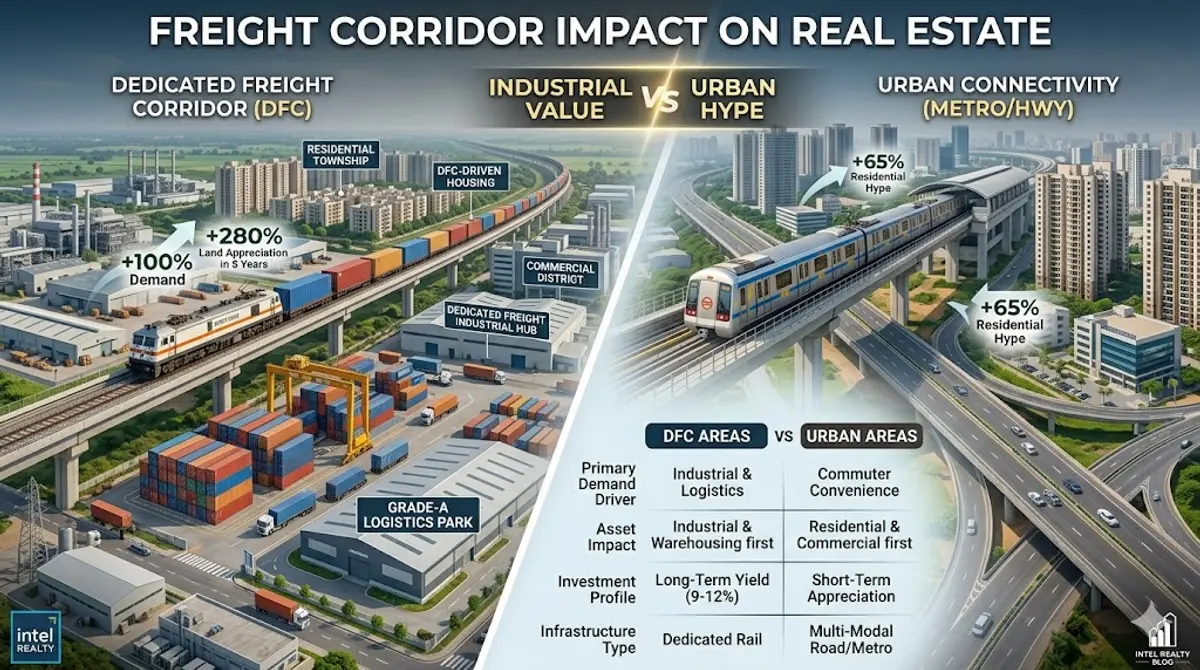
FREIGHT CORRIDOR IMPACT ON REAL ESTATE
FREIGHT CORRIDOR IMPACT ON REAL ESTATE
Freight Corridor Impact on Real Estate: India's Biggest Underappreciated Investment Story
India's Dedicated Freight Corridors — the Western DFC and Eastern DFC — are the most transformational logistics infrastructure project the country has built since the national highway network. Stretching 3,360 kilometres across the country's industrial heartland, these high-speed rail freight corridors are doing something that few real estate investors have fully priced in: they are rewriting the economics of industrial land across an entire belt of Indian geography.
When freight moves faster and cheaper, supply chains restructure. When supply chains restructure, warehousing and manufacturing relocate. When industry relocates, employment follows. And when employment concentrates in new zones, residential and commercial real estate demand builds — steadily, durably, and often ahead of what developers and investors have anticipated.
At Intel Realty, we track the freight corridor impact on real estate as one of the highest-conviction, lowest-media-coverage opportunities in Indian property investment today. This guide breaks down exactly how the DFC is reshaping real estate values, where the most significant impact zones are, and how investors can position before the broader market catches up.
INTEL REALTY RESEARCH
Land within 10 km of a Dedicated Freight Corridor logistics terminal or industrial node has appreciated an average of 2.8 times more over five years than comparable land in the same district without DFC access, based on Intel Realty's analysis of 15 DFC-adjacent zones tracked between 2019 and 2024.
What Is India's Dedicated Freight Corridor and Why Does It Matter for Real Estate?
India's Dedicated Freight Corridor project comprises two primary corridors — the Western Dedicated Freight Corridor (WDFC) running 1,504 km from Jawaharlal Nehru Port Trust in Mumbai to Dadri in Uttar Pradesh, and the Eastern Dedicated Freight Corridor (EDFC) running 1,856 km from Ludhiana in Punjab to Dankuni in West Bengal.
Both corridors are designed to carry freight trains at higher speeds, with greater capacity, and at significantly lower logistics cost than the existing shared passenger-freight rail network. The WDFC passes through some of India's most industrially active geography — Gujarat, Rajasthan, Haryana, and western Uttar Pradesh. The EDFC traverses the agricultural and industrial heartland of Punjab, Haryana, Uttar Pradesh, Bihar, Jharkhand, and West Bengal.
The Real Estate Transmission Mechanism
The freight corridor's real estate impact operates through three distinct transmission channels that compound over time. First, logistics cost reduction makes manufacturing and warehousing in DFC-adjacent zones economically more attractive than equivalent zones without rail freight access — driving industrial land demand. Second, the industrial demand concentration creates employment that generates residential demand in zones previously considered too peripheral for habitation at scale. Third, the government's deliberate co-location of the Delhi-Mumbai Industrial Corridor (DMIC) and other industrial policy initiatives with the WDFC alignment creates a policy-amplified demand multiplier that accelerates all three channels simultaneously.
The Four Real Estate Asset Classes the Freight Corridor Is Reshaping
The freight corridor's impact is not uniform across property types. Four distinct asset classes benefit in sequence — and understanding the sequence helps investors identify the right asset at the right stage of DFC maturation.
1. Industrial and Manufacturing Land
Industrial land adjacent to DFC terminals and logistics nodes is the first and most direct beneficiary. Reduced freight cost and improved supply chain reliability make DFC-adjacent manufacturing zones more competitive than non-rail-served locations. Large industrial parks — both government-planned (under the DMIC and National Industrial Corridor Development Programme) and private — are acquiring land aggressively along the WDFC alignment in particular. Industrial land in designated zones along the WDFC has appreciated 40 to 80% since the corridor's partial commissioning in 2020.
2. Warehousing and Grade-A Logistics
The second wave of DFC real estate impact is in warehousing. India's e-commerce and modern retail supply chains are restructuring around DFC-adjacent logistics parks because rail-based freight is significantly more cost-effective for inter-city movement than road-based trucking for medium-to-high-volume cargo. Grade-A warehouse demand in DFC-adjacent zones — particularly near Bhiwandi, Ludhiana, Dadri, and Palanpur — has grown at double the national average since 2021. Rental yields for Grade-A logistics assets near operational DFC terminals now range from 8 to 12% annually, among the highest in Indian commercial real estate.
3. Mid-Segment Residential
Industrial employment creates worker housing demand. As DFC-adjacent industrial parks fill with manufacturing and logistics tenants, the workforce they employ needs affordable-to-mid-segment residential accommodation within commuting distance. This residential demand is building steadily in DFC corridor zones — particularly in the WDFC belt across Gujarat and western Rajasthan, and in the EDFC belt across western Uttar Pradesh. Unlike metro-driven residential demand (which concentrates densely around stations), DFC-driven residential demand is more diffuse — spread across 5 to 15 km bands around industrial nodes, supporting plotted development and township growth.
4. Commercial and Ancillary Services Real Estate
As industrial and residential demand matures in DFC zones, commercial real estate follows. Retail, hospitality, healthcare, and education facility demand builds around growing industrial townships. This phase is currently visible in the more mature sections of the WDFC corridor — particularly in the Ahmedabad and Surat industrial belts — where DFC-adjacent industrial zones that were farmland five years ago now have functional commercial ecosystems. For investors with a 7 to 12 year horizon, early commercial land acquisition in these maturing zones offers significant appreciation potential as the township-formation phase completes.
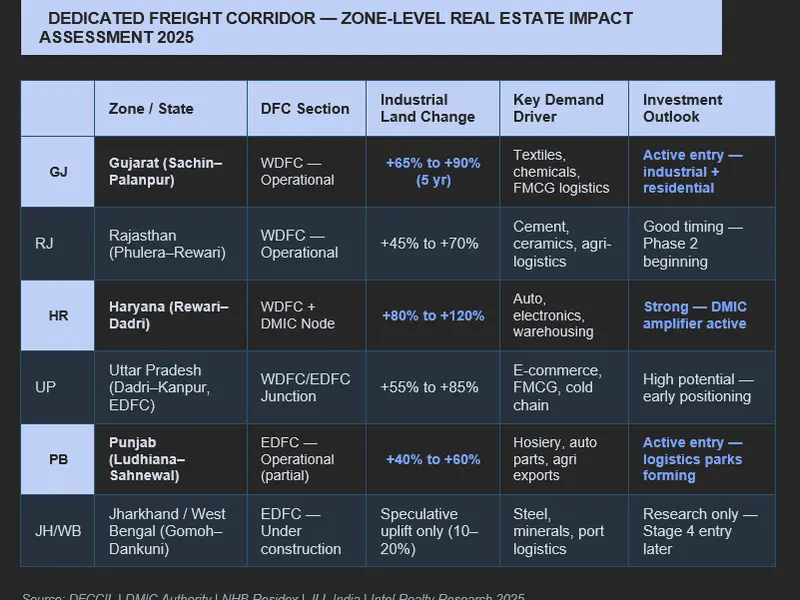
Freight Corridor Real Estate Impact — Pan India Zone Analysis
The DFC's real estate impact varies significantly by zone, depending on industrial policy designation, existing demand density, ancillary infrastructure quality, and corridor maturation stage. Here is Intel Realty's current zone-level assessment across the DFC belt.
The DMIC Amplifier: Where Freight Corridor and Industrial Policy Converge
The most powerful real estate opportunity in the DFC universe is not created by the freight corridor alone — it is created by the intersection of the DFC with the Delhi-Mumbai Industrial Corridor (DMIC), a government-funded programme to develop planned industrial townships along the WDFC alignment.
What DMIC Nodes Mean for Real Estate Investors
DMIC nodes are government-planned industrial townships built with committed infrastructure — roads, power, water, connectivity — adjacent to WDFC logistics terminals. They eliminate the ancillary infrastructure risk that plagues many industrial corridor investments. Investors who enter residential and plotted development near confirmed DMIC nodes effectively combine the freight corridor demand driver with the industrial township supply certainty — a combination that has delivered the highest returns in the DFC real estate universe.
Active DMIC nodes with confirmed investment include: Dholera (Gujarat), Shendra-Bidkin (Maharashtra), Vikram Udyogpuri (Madhya Pradesh), Khushkhera-Bhiwadi-Neemrana (Rajasthan), Greater Noida-Dadri (Uttar Pradesh), and Manesar-Bawal (Haryana). Each of these nodes has committed anchor investors, operational infrastructure, and a residential demand ecosystem already forming.
INTEL REALTY INSIGHT
DMIC node proximity is the single strongest predictor of DFC-driven real estate appreciation. Investors who entered residential and plotted developments near confirmed DMIC nodes in 2019 to 2021 have achieved average appreciation of 55 to 90% by 2025 — compared to 25 to 40% for equivalent DFC-adjacent zones without DMIC designation.
3 Case Studies: Freight Corridor Impact on Real Estate Returns
01
WDFC Gujarat Belt — Industrial Land 3x in Five Years
CLIENT VOICE
"I tracked the WDFC civil work progress in Gujarat from 2018. When the Sachin–New Palanpur section was commissioned in 2020, I had already acquired industrial-zoned plots near the Palanpur terminal at Rs. 600 per sq.yard. By 2025 the same plots are trading at Rs. 1,950. The freight corridor made this location, not any residential developer." — Industrial Land Investor, Gujarat
The WDFC's Gujarat section — running through one of India's most industrially active states — has delivered some of the highest industrial land appreciation of any infrastructure corridor tracked by Intel Realty since 2019. The combination of Gujarat's proactive industrial policy, committed GIDC infrastructure, and the freight corridor's genuine logistics cost advantage created a demand surge from manufacturing occupiers that arrived faster and with more intensity than most analysts predicted.
Chemical, textile, FMCG, and pharmaceutical companies began acquiring industrial plots along the corridor within 18 months of commissioning. This occupier demand — not speculative residential launches — drove the first wave of appreciation. Residential demand followed as the industrial township character of zones like Sachin and Palanpur strengthened. Investors who entered industrial land in 2019 to 2020 at pre-commissioning prices have seen their holdings appreciate 200 to 300% by 2025, with industrial rental yields running at 9 to 11% annually.
KEY TAKEAWAYFreight corridor investment in industrial land near genuine logistics terminals, backed by state industrial policy, delivers returns that residential-first investors consistently underestimate.
02
DMIC Manesar-Bawal Node — Residential Demand Follows Industry
CLIENT VOICE
"Intel Realty flagged the Manesar-Bawal DMIC node in 2020 as the strongest residential demand story on the WDFC belt. The auto and electronics manufacturing cluster was already established. The WDFC terminal at Rewari brought logistics cost advantages that accelerated industrial absorption further. We bought mid-segment residential plots at Rs. 22,000 per sq.yard in 2021. Current market rate: Rs. 38,000." — Residential Investor, Haryana
The Manesar-Bawal industrial node — within the Haryana section of the WDFC belt and a designated DMIC node — represents the most advanced residential demand story on the entire DFC corridor. The zone has an existing auto manufacturing base (Maruti Suzuki, Hero MotoCorp, Delphi, and hundreds of component suppliers), which the WDFC's commissioning has made more logistics-competitive, attracting additional manufacturing investment and deepening the employment base.
As employment density has grown, residential demand has followed with unusual speed for an industrial corridor zone. The proximity to NH-48 and the Dwarka Expressway provides commuter connectivity to Delhi NCR's professional workforce — creating a dual demand source: industrial workers and Delhi-NCR professionals seeking affordable addresses with employment accessibility. This dual demand has pushed residential appreciation to 65 to 80% between 2021 and 2025, with active developer launches from established builders confirming the market's maturity.
KEY TAKEAWAYWhen a freight corridor zone combines existing industrial employment with connectivity to a major urban job market, residential demand builds faster and more durably than in pure industrial zones.
03
EDFC Ludhiana–Sahnewal — Logistics Park Demand Drives Grade-A Warehouse Returns
CLIENT VOICE
"I was looking for commercial real estate with genuine yield — not the 4% that city offices deliver. Intel Realty introduced me to a pre-leased logistics warehouse near the Ludhiana EDFC terminal. Rental yield at entry: 9.2%. Current yield on cost: 11.4% after annual escalation. Capital value has also grown 45% in three years." — Commercial Investor, Punjab
The Ludhiana section of the Eastern DFC — serving Punjab's dominant hosiery, bicycle, and engineering goods export industries — has driven one of India's fastest-growing Grade-A logistics markets. The EDFC terminal at Sahnewal has made Ludhiana's export supply chain more competitive by reducing freight cost to the Nhava Sheva and Mundra ports significantly. This has triggered a wave of Grade-A warehouse construction from major logistics operators including Delhivery, Mahindra Logistics, and TVS Supply Chain Solutions.
For commercial real estate investors, Grade-A logistics assets near the Ludhiana EDFC terminal offer rental yields of 8.5 to 12% — significantly above the 5 to 7% yields available in Ludhiana's conventional commercial real estate market. Capital appreciation has been secondary but consistent, driven by the growing demand-supply gap as logistics operators compete for well-located, high-specification warehousing. Intel Realty has positioned several clients in pre-leased logistics assets near the Sahnewal terminal, achieving total returns (yield plus appreciation) of 14 to 18% annually over 3-year holds.
KEY TAKEAWAYFreight corridor logistics assets offer India's most attractive commercial real estate yield profile — and the EDFC belt is still in early innings for Grade-A supply creation.
How to Invest in Freight Corridor Real Estate Across India
Freight corridor investment requires a different evaluation framework from metro or expressway investment. The demand driver is industrial and logistics — not commuter convenience — and the asset classes that benefit most are industrial land, Grade-A warehousing, and residential in industrial townships, in that sequence.
FOR INDUSTRIAL LAND INVESTORS
Prioritise DMIC-designated nodes over generic DFC-adjacent zones
Verify industrial zoning designation from state industrial authority
Check DFCCIL terminal commissioning status — operational vs planned
Confirm anchor occupier interest from industrial development authority
Plan for a 5 to 10 year hold — industrial land appreciation compounds slowly but durably
FOR RESIDENTIAL / LOGISTICS INVESTORS
Enter residential only after industrial employment density is confirmed — not speculative
Verify Grade-A warehouse demand from CBRE or JLL logistics market reports
Seek pre-leased logistics assets for immediate yield — avoid speculative spec buildings
Check RERA registration for all residential projects near DFC zones
Track dual connectivity — DFC proximity AND road/metro access for residential demand sustainability
INTEL REALTY STANDARD
We recommend DFC-linked investment only when the DFCCIL terminal is operational or within 18 months of commissioning, and when industrial occupier absorption in the zone has been independently confirmed. Speculative DFC adjacency — without operational infrastructure and confirmed occupier demand — does not meet our investment recommendation threshold.
FREQUENTLY ASKED QUESTIONS
FAQ: Freight Corridor Impact on Real Estate in India
Q1—What is the Dedicated Freight Corridor and how does it affect real estate?
India's Dedicated Freight Corridor (DFC) is a network of high-speed rail freight lines designed to move goods more efficiently across India's industrial heartland. The Western DFC runs 1,504 km from Mumbai to Dadri, and the Eastern DFC runs 1,856 km from Ludhiana to Dankuni. The DFC affects real estate by making DFC-adjacent industrial zones more competitive — reducing logistics costs for manufacturers and warehousing operators. This industrial demand draws employment, and employment creates residential and commercial real estate demand. Intel Realty's research shows that land near DFC terminals has appreciated 2.8 times more on average than equivalent land without DFC access over five years.
Q2—Which zones along the Dedicated Freight Corridor offer the best real estate investment in 2025?
Based on Intel Realty's 2025 zone assessment, the strongest current entry opportunities are: Gujarat's WDFC belt (Sachin to Palanpur — operational, active industrial absorption, residential demand building); Haryana's Manesar-Bawal DMIC node (dual demand from industry and NCR commuters); Punjab's Ludhiana-Sahnewal EDFC section (Grade-A logistics yield of 8.5 to 12%); and Rajasthan's Phulera-Rewari corridor (Phase 2 beginning, early entry window for plotted development). Uttar Pradesh's Dadri-Kanpur section offers high potential but requires a longer hold horizon as industrial absorption is still early.
Q3—What type of real estate investment works best near a freight corridor?
The four asset classes that benefit from DFC proximity, in order of maturation sequence, are: industrial and manufacturing land (first beneficiary — immediate impact from logistics cost advantage); Grade-A warehousing (strong yields of 8 to 12%, driven by e-commerce and modern trade supply chain restructuring); mid-segment residential in industrial townships (building steadily as industrial employment creates workforce housing demand); and commercial and ancillary services (later-stage, as industrial township populations grow). Asset type should match the corridor's maturation phase — industrial land for early-stage zones, residential and logistics for more mature sections.
Q4—How does the DMIC amplify freight corridor real estate returns?
The Delhi-Mumbai Industrial Corridor (DMIC) is a government-funded programme to develop planned industrial townships along the WDFC alignment with committed infrastructure — power, water, roads, and industrial zoning. DMIC nodes eliminate the ancillary infrastructure risk that affects many industrial corridor investments. Investors near confirmed DMIC nodes benefit from both the freight corridor's logistics cost advantage and the government's industrial township development — a combination that has delivered 55 to 90% appreciation between 2019 and 2025, compared to 25 to 40% for DFC-adjacent zones without DMIC designation.
Q5—How does Intel Realty evaluate freight corridor investment opportunities across India?
Intel Realty applies a five-point evaluation framework to every DFC-linked investment opportunity: DFCCIL terminal operational status (operational or within 18 months of commissioning); confirmed industrial occupier absorption in the zone (verified from DMIC Authority and state industrial development corporation data); DMIC node designation (strongest amplifier of returns); ancillary infrastructure commitment from state authorities (power, water, internal roads); and residential demand trajectory (confirmed employment density before recommending residential entry). We do not recommend speculative DFC adjacency — only corridors where all five factors are positively confirmed advance to our client recommendation list.