
Gurugram Real Estate Agent Consolidation: The Broker Crisis
The Institutionalization of the Brokerage Landscape
For nearly three decades, the National Capital Region's real estate market operated as a playground for the hyper-localized independent broker. Armed with little more than a mobile phone, personal network connections, and a basic workspace, an estimated 30,000 unorganized agents drove the secondary and primary transaction volumes across Gurugram.
However, by 2026, the market has reached a structural tipping point. The era of the fragmented freelance broker is rapidly drawing to a close, replaced by a highly institutionalized environment defined by strict regulatory enforcement and technological integration.
This systemic transformation—known as The Consolidation Curve—is squeezing the financial viability of unorganized operators. Driven by the expansion of the Haryana Real Estate Regulatory Authority's (HRERA) compliance cells, the rise of massive corporate Channel Partners (CPs), and the market dominance of full-stack PropTech platforms, the independent agent is facing an existential crisis. The market is shifting from local personal networks to corporate trust frameworks, data security infrastructure, and institutional compliance protocols.
The Regulatory Squeeze: HRERA’s Compliance Enforcement
The primary catalyst behind this massive consolidation is the aggressive regulatory shift implemented by HRERA Gurugram. Historically, real estate agent registration was viewed as a minor procedural step. In the current 2026 operational landscape, it has transformed into a comprehensive legal framework.
The introduction of automated audit cells now matches every primary transaction with a verified, active HRERA broker identification profile. Independent agents who previously operated under the umbrella registrations of larger agencies or engaged in informal verbal agreements are being systematically cut out from developer commission structures.
Furthermore, strict mandates governing marketing practices mean that advertising an unapproved project layout or making undocumented financial promises carries severe, immediate penalties. For a solo operator lacking dedicated legal and compliance teams, navigating this changing legal environment has become an expensive, high-risk challenge.
Data Analysis: The Transition of Brokerage Market Share
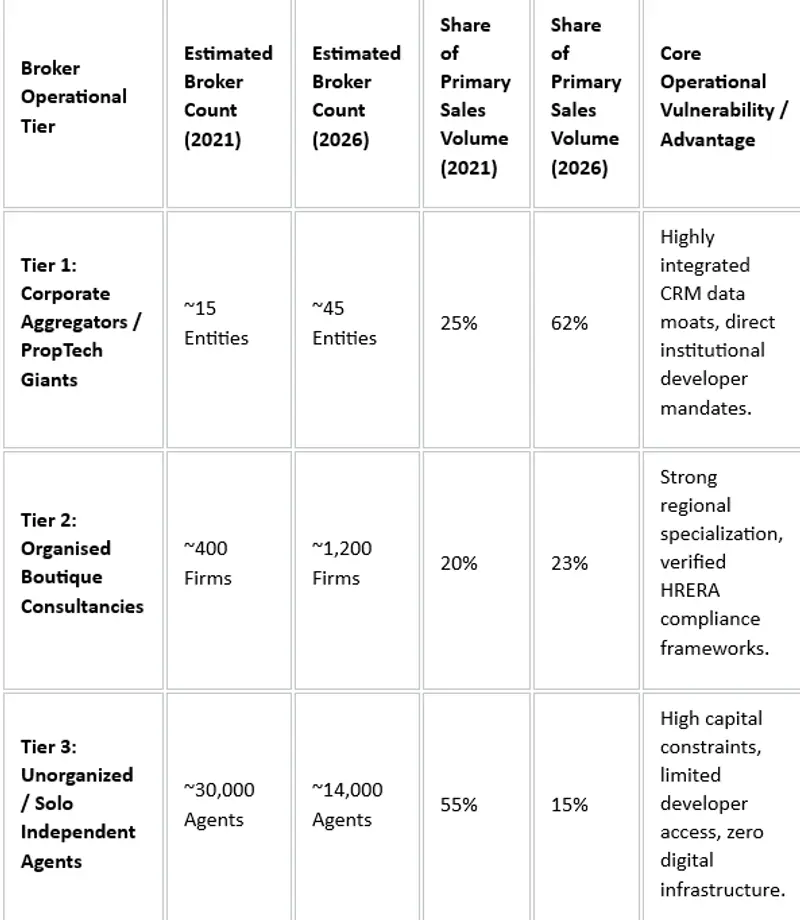
The rapid shift of residential and commercial primary sales volumes from unorganized independent networks to institutionalized corporate brokerages is clearly visible in the market metrics:
Structural Interpretation
The data shows a clear shift: over 50% of independent operators have exited the market or been absorbed into larger corporate entities over the last five years. Tier 1 corporate aggregators have capitalized on this landscape, growing their primary sales volume share from 25% to 62%, establishing a clear market dominance.
The Tech Gap: Why Legacy Networks Are Failing
Beyond the expanding regulatory landscape, the survival of the independent agent is deeply threatened by a widening technology gap. Top-tier developers launching projects along the Dwarka Expressway or Southern Peripheral Road (SPR) no longer manage inventory via manual spreadsheets or phone check-ins.
Modern launch protocols require immediate integration with advanced, cloud-based CRM portals. These corporate systems automate the distribution of unit availability, calculate real-time pricing configurations, and track complex commission milestones.
The Tech Isolation Cycle for Unorganized Agents
[Zero CRM Architecture] ➔ [No Access to Live Developer Inventory] ➔ [Delayed Buyer Responses] ➔ [Loss of Market Share]
Corporate aggregators provide their direct teams and aligned sub-agents with instant access to these digital systems. A solo agent operating without this real-time visibility cannot provide institutional-grade response speeds to prospective buyers, leading to a steady loss of competitive advantage.
The Strategic Path Forward: Adapt or Dissolve
For the remaining independent agents across Gurugram, surviving the consolidation curve requires a fundamental change in business strategy:
- Transitioning to Aligned Sub-Broker Models: Solo operators must move away from attempting to secure direct developer mandates. Instead, they need to integrate their hyper-local network into the infrastructure of established corporate aggregators, trading a portion of their commission for access to live inventory databases and compliance coverage.
- Specializing in Boutique Secondary Portfolios: While corporate aggregators excel at volume-driven primary project launches, the highly fragmented secondary resale and residential leasing market requires personal touchpoints and local expertise. Independent operators can protect their business by focusing heavily on micro-market resale portfolios.
- Investing in Fundamental Professional Certifications: Agents must formalize their operational profiles by securing active individual HRERA licenses, establishing valid GST reporting, and completing professional real estate valuation courses to match the standards of corporate advisory firms.
The Catalysts Behind the Shift
This shift from hyper-fragmentation to an institutional oligopoly did not happen in a vacuum. It is the direct consequence of three macroeconomic and regulatory forces:
- Regulatory De-risking via HRERA: The implementation and subsequent strict enforcement of the Haryana Real Estate Regulatory Authority (HRERA) put an end to the aggressive customer-funded capital cycles that weak developers relied upon. Requirements for escrow accounts, strict delivery timelines, and massive penalties for diversion of funds eliminated operators lacking deep balance sheets.
- The NBFC Crisis and Liquidity Squeeze: The structural collapse of major non-banking financial companies (NBFCs) cut off the unorganized sector from its primary source of high-leverage debt. Institutional capital, private equity houses, and banking syndicates shifted their mandates to fund only developers with spotless corporate governance structures.
- The Consumer Flight to Quality: After witnessing massive project delays in the early 2010s, modern property buyers changed their criteria. Today’s buyers are willing to pay a premium of 20% to 35% for a project backed by a tier-1, corporate-governed developer rather than gamble on an unbranded alternative.
FAQ Section
1. Why are unorganized agents losing access to direct primary project launches in Gurugram?
Top-tier real estate developers increasingly look for high sales volume velocity, clean regulatory profiles, and institutional compliance standards from their distribution partners. Lacking the capacity to coordinate with thousands of individual agents, developers are centralizing their sales distribution through a select tier of corporate channel partners and PropTech aggregators.
2. How are HRERA audit cells impacting independent brokers?
HRERA audit cells systematically track property registrations against licensed agent records. If a transaction involves an unregistered or non-compliant broker, the platform flags the transaction, stopping commission payouts from the developer's RERA-monitored escrow accounts.
3. Can an independent broker continue to operate without an integrated CRM platform?
While legally permissible with a valid individual HRERA license, operating without an integrated CRM is a major competitive disadvantage. The modern Gurugram market operates at high speed, with project inventories shifting within hours. Lacking real-time access to unit allocations makes it incredibly difficult to serve sophisticated, data-driven buyers.
4. What percentage of Gurugram's traditional brokers have left the market?
Market transitions up to 2026 indicate that more than 50% of the city’s unorganized freelance agents have either exited the industry entirely or transitioned into corporate sales advisory roles within larger, institutionalized PropTech firms.
5. How did HRERA accelerate this market consolidation?
HRERA introduced strict compliance laws requiring developers to place 70% of project receivables into a dedicated escrow account used exclusively for construction. This eliminated the predatory industry practice of using cash flows from Project A to buy land for Project B. Developers without independent capital or institutional backing found themselves facing terminal liquidity shortages, forcing them out of active operations.
6. Why are corporate real estate developers able to price their projects higher than local alternatives?
Corporate developers command a "trust premium" (often ranging from 20% to 35%). Buyers gladly pay this for guaranteed timely delivery, high corporate governance standards, superior construction engineering, and institutional asset management post-handover. This reduces the risk premium associated with long-term real estate investments.