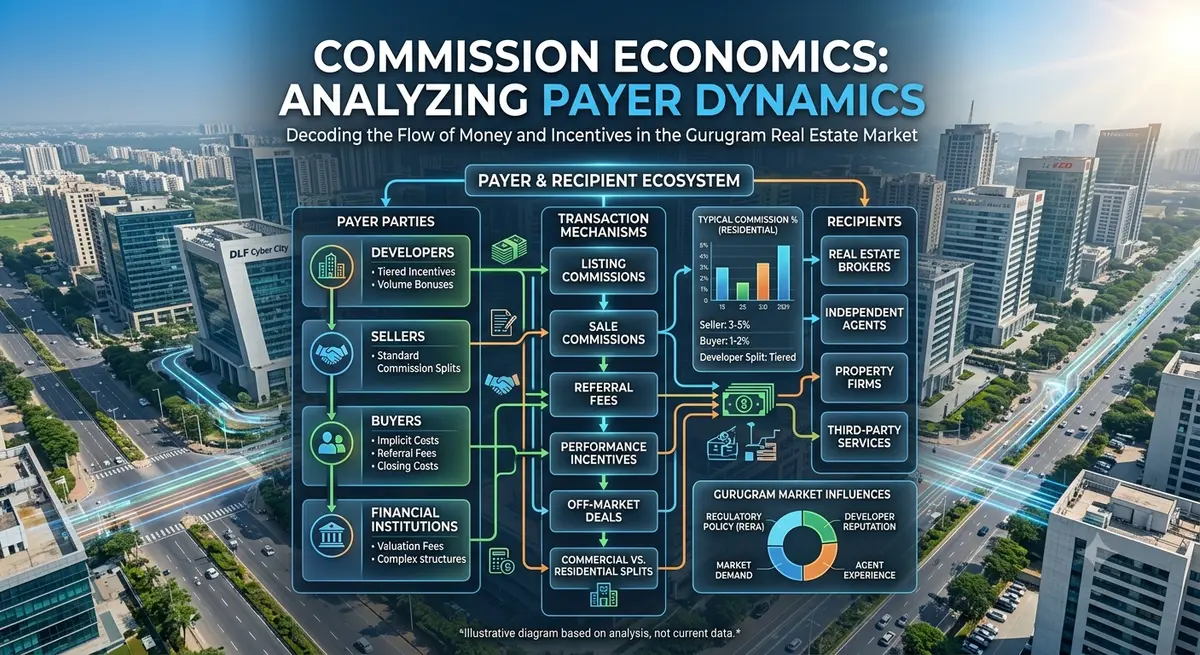
Gurugram Real Estate Commission Structure: Payer Dynamics
The Structural Redefinition of Transaction Inflows
In the financial ecosystem of urban real estate, the mechanics governing commission payouts are rarely static. However, few micro-markets across Asia match the complexity, scale, and velocity of the transaction fees seen in Gurugram. As property capital benchmarks climb across premium and luxury segments, the underlying financial arrangements between developers, purchasers, brokers, and aggregators have undergone a structural transformation.
The central driver of this transformation is a distinct divide in the Gurugram real estate commission structure. The market splits into two completely different operational models: a high-incentive, volume-driven primary market powered by developer payouts, and a highly competitive, double-sided transaction fee environment in the secondary market.
Understanding these capital flows is essential for institutional underwriters, corporate brokerages, and sophisticated property investors looking to optimize transaction strategies across the National Capital Region.
The Primary Market Engine: The Evolution of Developer Payouts
In the primary residential and commercial segment, the payer dynamic is heavily weighted toward the developer. With major project launches demanding rapid inventory absorption to secure construction cash flows, top-tier builders look to corporate channel partner (CP) networks to drive sales velocity.
Primary Market Payout Progression Loop
[Booking Amount Cleared] ➔ [10-20% Initial Payout] ➔ [Construction Milestones] ➔ [Tranche Commission Releases]
Standard baseline commission structures within the primary premium segment hover between 2% and 4% of the total property value. However, during high-stakes pre-launch windows or for complex commercial properties like Shop-Cum-Office (SCO) plots, developers frequently introduce staggered, high-incentive milestone metrics.
These structures can reach levels of 5% to 8%, often including early-volume triggers, luxury vehicle incentives, or direct year-end performance bonuses. Crucially, these distributions are governed by HRERA escrow rules, ensuring that commission budgets are accounted for within the project's broader financial planning.
The Secondary Market Split: Traditional Fee Realities
In contrast to the developer-funded primary market, the secondary resale and leasing market operates under a traditional double-sided fee structure. This segment requires a balanced negotiation approach, as brokers must secure revenue directly from the transacting parties rather than a corporate marketing budget.
- The Standard Transaction Slab: The established benchmark for standard residential and commercial resales is a 1% + 1% fee model, where both the property seller and the incoming purchaser contribute an equal 1% transaction fee to the facilitating agency.
- The Premium Friction Point: As luxury property deals increasingly cross the ₹15 Crore mark, buyers are pushing back on the traditional flat 1% fee structure. This has led corporate brokerages to adopt tiered fee models, tapering commission requirements to 0.5% or 0.75% for high-ticket transactions while compensating through extended post-sale property management mandates.
Risk Parameters & Escrow Integration Under HRERA
For corporate brokerages operating at scale, protecting commission collections requires a deep understanding of local regulatory guardrails:
- Escrow Account Allocations (Section 4): HRERA regulations dictate that 70% of all client inflows must remain locked within the project's dedicated construction and land escrow account. Developers fund channel partner commissions out of the remaining 30% operational capital pool. Consequently, tracking a developer's macro liquidity profile is essential to avoid collection delays.
- Clawback Risk in Canceled Bookings: Standard corporate primary contracts feature structural clawback provisions. If a homebuyer defaults on early construction milestones or cancels the booking before the builder-buyer agreement (BBA) is formally signed, the developer can freeze or claw back the paid broker commission, posing a financial risk to the agency.
The Architecture of the Modern Commission Framework
Contemporary developer-broker commission contracts are structured around clear performance expectations:
- The Baseline Fee: For standard premium residential projects, the base commission typically ranges between 2% and 4% of the basic sale price (BSP). This fee is triggered once the end-consumer clears the initial booking amount and executes the formal Builder-Buyer Agreement (BBA).
- Volume-Linked Accelerators (The "Kickers"): To incentivize large corporate brokerages, developers deploy progressive step-up structures. For example, a firm might earn a 3% base commission on its first 5 transactions, but if total quarterly sales exceed a milestone like ₹50 Crores, the commission rate retroactively scales to 5% or 6% across all deals.
- Inventory-Specific Subsidies: Slow-moving inventory—such as massive penthouses, lower-floor units with obstructed views, or projects in early civil approval stages—frequently carry specialized short-term incentives. These can spike commission payouts up to 7% to 9%, providing massive immediate revenue to teams that can clear challenging listings.
Clawbacks, Milestones, and Retention Risk Management
To insulate themselves from speculative buyers who default after making initial payments, institutional developers have implemented rigorous risk-mitigation terms into broker contracts:
- Milestone-Linked Tranches: Commissions are rarely paid out as a single lump sum. Instead, they are disbursed across clear construction milestones: 50% upon BBA execution and customer clearing of the first 20% payment, 25% upon completion of the sub-structure/plinth, and the remaining 25% upon completion of the superstructure.
- Clawback Clauses: If an investor defaults on subsequent construction-linked demands within the first 12 months, developers enforce explicit clawback provisions. The broker must either substitute the defaulting client with a new qualified buyer or forfeit/refund the disbursed commission allocations against future accounts receivable.
Frequently Asked Questions (FAQs)
What is the standard real estate broker commission rate in Gurgaon?
While the legacy secondary market still sees standard 1% to 2% fees paid by both buyer and seller, the dominant primary launch market features developer-paid commissions ranging between 3% and 6% of the base sale price. This varies depending on the scale of the brokerage firm and the total volume of inventory shifted.
What are volume-linked commission kickers?
Volume-linked kickers are performance multipliers built into broker contracts. A developer might offer a baseline 3% commission, but promise that if the brokerage house clears more than 10 units within a calendar month, the payout rate retroactively scales up to 5% or 6% for the entire tranche of deals.
How do developers protect themselves from paying commissions on buyers who later default?
Developers manage this through milestone-linked payment schedules and clawback clauses. Instead of paying the full commission immediately upon booking, the money is released across major project milestones (e.g., 50% post-BBA execution, and the remaining 50% tied to the customer clearing their next major construction payment installments).
Who pays the broker commission when purchasing a newly launched property in Gurugram?
In the primary market, the commission fee is paid entirely by the real estate developer out of their allocated corporate marketing and distribution budgets. Under standard market practices, the individual purchaser faces zero direct service fee liabilities to the facilitating channel partner.
What is the standard transaction fee applied to secondary market property resales?
The baseline market standard for a secondary property resale stands at a balanced 2% total commission layout. This fee structure is split evenly as a 1% charge to the seller and a 1% charge to the buyer, paid upon the formal completion of the property transfer registry.
Why do developers offer higher commission scales for commercial and SCO assets?
Commercial assets, retail spaces, and SCO plots typically require more complex investor targeting and extended advisory timelines compared to traditional residential apartments. To attract top corporate channel partners and accelerate absorption speeds across these large-scale commercial developments, builders offer enhanced commission scales ranging from 5% to 8%.