
HRERA Audit: How Transparency Stabilized Gurugram Real Estate
The HRERA Audit: How Regulatory Transparency Stabilized Gurugram’s GTV
The landscape of Gurugram real estate was once frequently equated with a high-yield yet high-risk frontier. Prior to robust regulatory enforcement, the market was prone to volatile price swings, severe project delays, and a pronounced deficit in homebuyer trust.
However, the implementation of systemic HRERA audit Gurugram real estate compliance frameworks has profoundly shifted this dynamic. By introducing rigorous operational oversight, the Haryana Real Estate Regulatory Authority (HRERA) has turned India’s millennium city into a highly transparent, predictable, and resilient property market.
This structural evolution has directly influenced the city's Gross Transaction Value (GTV). Instead of driving capital away, tighter regulatory scrutiny has consolidated capital into high-value, compliant developments, anchoring the sustained upward trajectory of property investment in Gurgaon.
The Evolution of Accountability: From Speculation to Systemic Audits
Before the enactment of the Real Estate (Regulation and Development) Act (RERA) and the subsequent establishment of the HRERA Gurugram bench, the micro-markets of Gurgaon operated on structural asymmetry. Developers routinely diverted capital from ongoing projects to acquire new land banks, resulting in systemic execution delays and cascading liquidity crises.
The introduction of the comprehensive HRERA audit Gurugram real estate mechanism fundamentally altered developer behavior by introducing strict financial discipline:
- Elimination of Malpractices: The elimination of fraudulent or undercapitalized promoters who cannot sustain operations under structural compliance.
- Leveling the Playing Field: The creation of a healthier development ecosystem where credible builders face less competition from unscrupulous operators.
- Risk Mitigation: The transition of the market from a speculative, short-term betting arena into a stable institutional asset class.
This regulatory evolution has ensured that capital injected into the market is directly utilized for project execution, minimizing default risks and establishing a reliable floor for Gurugram real estate market trends.
Anatomy of a HRERA Compliance Audit: What Developers Face
The structural stability of Gurugram’s modern real estate market is built upon a continuous, multi-tiered auditing infrastructure. HRERA does not merely review projects at initialization; it maintains active operational oversight throughout the entire lifecycle of a development.
A. Mandatory Project Escrow Accounts (The 70/30 Rule)
Under the current framework, developers must deposit 70% of all project collections from allottees into a dedicated, separate escrow bank account. These funds are explicitly restricted for land acquisition and construction costs.
To withdraw money from this account during development, promoters must submit professional certifications from the project architect, a structural engineer, and a practicing chartered accountant. This ensures that cash flow exactly matches physical construction progress.
B. Compulsory Quarterly Progress Reports (QPRs)
Transparency is enforced through mandatory public accountability. Developers are legally required to upload detailed Quarterly Progress Reports (QPRs) to the official HRERA Gurugram portal. These public records must disclose:
- The exact number of units sold versus available inventory.
- Updated layout plans, structural approvals, and construction milestones achieved.
- Financial statements detailing funds collected, utilized, and remaining in the escrow account.
Failure to submit these reports regularly triggers strict financial penalties, public warning flags on the portal, or the eventual suspension of the project's registration certificate.
C. Enhanced Domain Expert Scrutiny
Recent compliance updates have integrated mandatory field inspections by independent domain experts and technical auditors appointed by the authority. These inspections cross-verify the structural integrity and physical alignment of the project against the initial marketing and architectural plans submitted during registration.
Quantifying the Stabilization: GTV and Capital Inflows
A common misconception among legacy operators was that increased regulation would strangle market velocity. The actual market performance data highlights the exact opposite effect. By lowering default risks, regulatory compliance has unlocked massive institutional and retail capital.
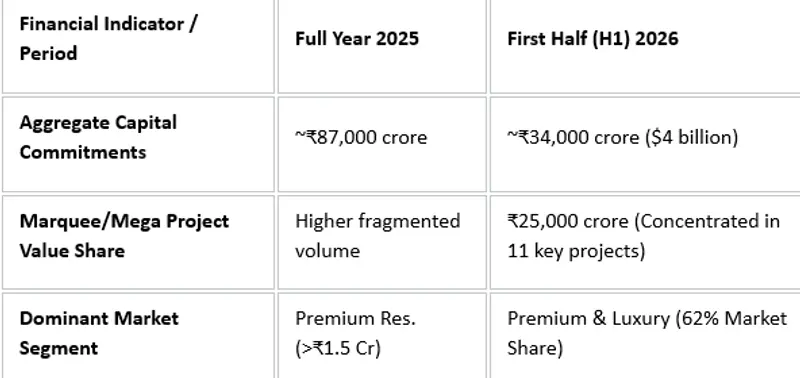
During the first six months of 2026, the HRERA Gurugram authority cleared 51 mega projects involving an aggregate capital commitment of nearly ₹34,000 crore (approximately $4 billion). A deeper analysis reveals that 11 of these large-scale developments alone commanded ₹25,000 crore of the total investment pipeline. This clear concentration of capital within massive, audited residential and commercial developments highlights the unprecedented stability of the modern market.
The Institutional Shift: Why NRIs and Global PE Funds Prefer Audited Markets
The primary beneficiary of the institutionalized HRERA audit Gurugram real estate ecosystem is the premium and luxury asset class. Large institutional investors, global Private Equity (PE) firms, and Non-Resident Indians (NRIs) require deep financial transparency before committing capital.
Expert Market Insight: The premium housing segment (properties valued above ₹1.5 crore) captured over 62% of total market transactions. This dynamic proves that buyers are willing to pay a premium for verified asset quality and regulatory protection.
Global capital chooses Gurugram for three distinct reasons:
- Fast-Track Dispute Resolution: HRERA has systemically reduced its legacy consumer complaint backlogs through fast-track mediation forums, drastically lowering the duration of legal disputes.
- Mitigation of Execution Risks: Real-time visibility into escrow accounts reduces the risk of project abandonment, a factor that historically deterred foreign direct investment (FDI).
- Standardized Measurement: The mandatory transition to selling exclusively via standardized carpet area rather than ambiguous super built-up areas has eliminated hidden transaction friction.
Structured Checklist: Verifying Project Compliance Before Investing
For domestic buyers, corporate entities, and NRIs planning a property investment in Gurgaon, verifying a developer's compliance status is an essential risk-management step.
- Step 1: Extract the Unique HRERA Number — Ensure all marketing collateral, brochures, and digital advertisements explicitly display the valid alpha-numeric registration number (e.g., RC/REP/HARERA/GGM/...).
- Step 2: Execute a Portal Search — Navigate to the official HRERA Gurugram portal and input the registration number under the 'Project Search' module.
- Step 3: Analyze the QPR History — Review the project's historical quarterly uploads. Cross-verify if the actual physical completion percentage declared matches your on-site observations.
- Step 4: Check for Active Legal Litigations — Inspect the portal's cause lists and judgment logs to check if the specific promoter has active executing complaints, severe penalties, or default notices pending against them.
Frequently Asked Questions (FAQ)
Q1: How does a HRERA audit protect a homebuyer’s financial investment?
A HRERA audit ensures that 70% of all buyer capital is maintained within a project-specific escrow account, completely preventing the developer from diverting funds to other land acquisitions or external projects. Withdrawals from this account are strictly regulated and must be certified by an independent architect, engineer, and chartered accountant to match actual physical construction progress.
Q2: Where can I check if a Gurugram real estate project is genuinely HRERA approved?
You can verify the authentic status of any development by visiting the official Haryana Real Estate Regulatory Authority portal (haryanarera.gov.in or hareraggm.com). Simply navigate to the 'Project Search' section and enter the developer's unique HRERA registration number to view their full compliance history, quarterly progress records, and approved site plans.
Q3: What happens to a developer who fails their quarterly HRERA compliance audit?
Developers who fail to submit their Quarterly Progress Reports (QPRs) or are found misrepresenting construction milestones face severe penalties. These can include heavy financial fines, public flags on the official portal labeling the project as non-compliant, freezing of the project escrow account, or the complete cancellation of the project's registration certificate.
Q4: Why is Gross Transaction Value (GTV) stabilizing despite rising property prices in Gurgaon?
Gurugram's GTV is stabilizing because the market has shifted from short-term speculative buying to long-term end-user and institutional investment. Because HRERA compliance has significantly reduced project default risks, buyers are confidently purchasing premium and luxury properties, creating stable, non-inflationary transaction volume growth backed by physical asset value.
Q5: Can an NRI securely invest in non-HRERA registered properties in Haryana?
Investing in non-HRERA registered developments carries extreme financial and legal risk. Under Section 3 of the RERA Act, developers cannot legally market, advertise, book, or sell any property within a planning area without formal registration. Non-registered properties lack regulatory protection, offer no escrow tracking, and are excluded from the fast-track dispute resolution mechanisms provided by the authority.