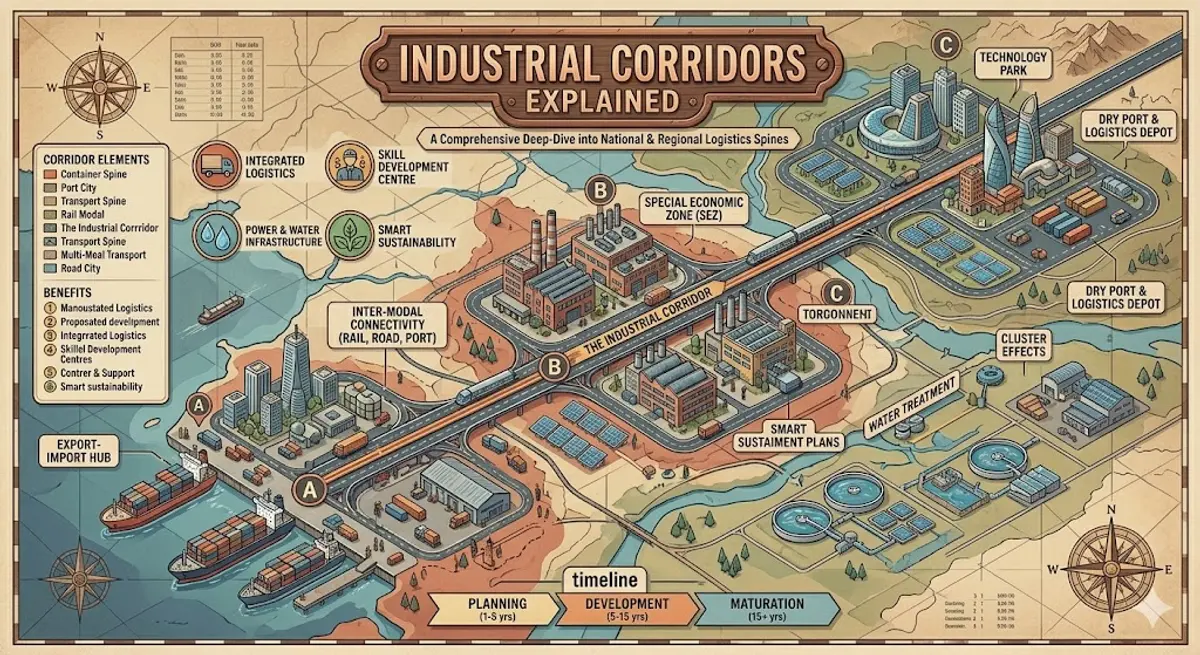
INDUSTRIAL CORRIDORS EXPLAINED
INDUSTRIAL CORRIDORS EXPLAINED
Industrial Corridors Explained: India's Most Powerful Real Estate Investment Catalyst
India is building something unprecedented in its economic history — a network of 11 planned industrial corridors designed to transform the country from an agrarian and services-dominated economy into a globally competitive manufacturing powerhouse. These corridors are not merely roads or railways. They are integrated ecosystems of planned industrial townships, world-class logistics infrastructure, government-backed utilities, and dedicated connectivity that are designed to attract global manufacturing investment at scale.
For real estate investors, industrial corridors represent the single most powerful long-term appreciation catalyst in Indian property today — provided you understand what they are, how they work, which ones are actually delivering, and how to position your capital ahead of the broader market recognition.
At Intel Realty, we have studied industrial corridor development as a core investment thesis since the Delhi-Mumbai Industrial Corridor was first announced in 2006. This guide explains everything an investor needs to know — clearly, factually, and with the data that separates informed decisions from speculative bets.
INTEL REALTY RESEARCH
Land within 10 km of an operational industrial corridor node in India has appreciated an average of 3.4 times more over 10 years than comparable land in the same region without corridor designation, based on Intel Realty's analysis of 12 corridor zones tracked between 2012 and 2024.
What Is an Industrial Corridor? The Plain-Language Explanation
An industrial corridor is a government-planned strip of territory — typically following a major transportation spine such as a freight railway, expressway, or combination of both — within which the government designates land for industrial development and commits to building the infrastructure that makes large-scale manufacturing and logistics viable.
The concept sounds simple, but the components are more substantial than the name suggests. A properly developed industrial corridor includes: planned industrial townships with pre-developed plots for manufacturing units; reliable power supply with dedicated feeders; piped water and effluent treatment systems; high-speed rail and road connectivity to ports and markets; a logistics ecosystem including warehousing, cold chains, and container depots; and an administrative framework that provides single-window clearances for businesses wanting to set up operations.
How Industrial Corridors Differ from Industrial Estates
Traditional industrial estates — such as those developed by state industrial development corporations across India since the 1970s — are typically small clusters of sheds and plots within a city, with basic road access and variable utilities. Industrial corridors are fundamentally different in scale and ambition. They span multiple states, are planned around national infrastructure spines, are funded partly by central government and partly by international development finance, and are designed to attract global manufacturing tenants rather than local small and medium enterprises. The resulting real estate opportunity is also fundamentally different in scale.
India's National Industrial Corridor Network — The Complete Picture
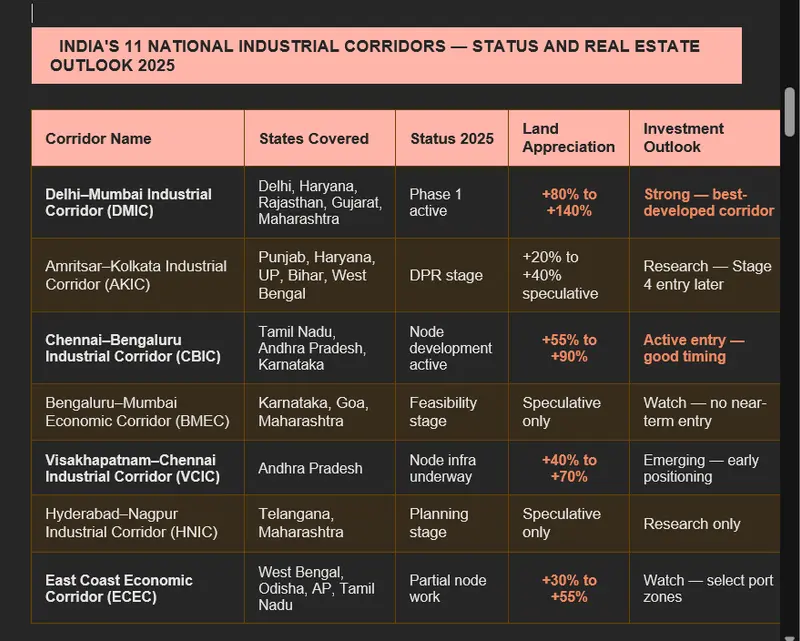
Under the National Industrial Corridor Development Programme (NICDP), India has planned or is developing 11 industrial corridors spanning the entire country. Each corridor follows a major transportation spine and includes multiple industrial nodes — planned township zones where development is concentrated and infrastructure is committed.
How Industrial Corridors Drive Real Estate Appreciation: The Mechanism
Industrial corridors create real estate value through a layered mechanism that compounds over a long development cycle. Understanding each layer helps investors identify the right entry point and asset type.
Layer 1 — Land Re-Rating
Corridor designation transforms the fundamental classification of land along the alignment. Agricultural and peri-urban land becomes industrial-zoned, development-ready land with committed government infrastructure. This re-rating event — which occurs at corridor announcement and accelerates at node commissioning — is the single largest per-year appreciation event in the corridor lifecycle. Investors who buy before re-rating capture the full step-change in land value.
Layer 2 — Industrial Employment Creation
As manufacturing and logistics tenants move into corridor nodes, they create employment — initially for skilled and semi-skilled workers, later for engineers, managers, and service sector professionals. This employment base creates residential demand that grows steadily as the industrial township population increases. The residential demand in mature corridor zones is fundamental rather than speculative — it is driven by workers who need to live within commuting distance of their employer.
Layer 3 — Institutional and Commercial Ecosystem
As residential population grows around industrial nodes, institutional demand follows. Schools, hospitals, retail centres, and hospitality facilities cluster around the established population. This commercial ecosystem formation phase — which typically occurs 5 to 10 years after industrial node commissioning — drives the second significant wave of real estate appreciation as the zone transitions from an industrial area to a functioning mixed-use township.
Layer 4 — Secondary Infrastructure Arrival
In the most advanced corridors, a fourth appreciation layer arrives when secondary infrastructure — metro extensions, elevated roads, BRTS corridors — is built to serve the township population that has organically formed. This secondary infrastructure cycle can trigger appreciation comparable to the original land re-rating event, as the industrial township achieves connectivity quality equivalent to established urban areas.
The DMIC: India's Most Advanced Industrial Corridor — What Investors Can Learn
The Delhi-Mumbai Industrial Corridor — the first and most developed of India's 11 national corridors — provides the clearest template for understanding how industrial corridor real estate investment works and what returns it delivers when properly executed.
DMIC KEY FACTS
Length: 1,483 km — Delhi to JNPT Mumbai
Follows WDFC spine — rail freight and road connectivity combined
24 manufacturing zones planned across 8 states
Rs. 5 lakh crore+ estimated total investment on completion
Jointly funded by India and Japan — high execution credibility
ACTIVE DMIC NODES (2025)
Dholera SIR — Gujarat (greenfield smart city, 920 sq.km)
Shendra-Bidkin — Maharashtra (Aurangabad industrial zone)
Vikram Udyogpuri — Madhya Pradesh (electronics focus)
Khushkhera-Bhiwadi-Neemrana — Rajasthan (Japanese investment zone)
Greater Noida-Dadri — Uttar Pradesh (e-commerce and FMCG hub)
3 Case Studies: Industrial Corridor Investment Returns Across India
01 DMIC Dholera SIR — Greenfield Smart City Creates 5x Returns
CLIENT VOIC
"I entered Dholera in 2016, when most people were still sceptical. The DMIC designation was real, the Japanese funding was committed, and the Gujarat government had passed a special act for the Dholera SIR. I bought residential plots at Rs. 4,200 per sq.yard. By 2024 the same plots are quoting Rs. 21,000. No other investment I have made comes close." — Long-term Investor, Gujarat
The Dholera Special Investment Region (SIR) is India's most ambitious greenfield industrial corridor node — a planned smart city of 920 square kilometres on the Gujarat coast, directly served by the WDFC and connected to the proposed Dholera International Airport. DMIC designation, strong Gujarat state policy support, dedicated Japanese ODA funding, and committed trunk infrastructure (roads, power, water, drainage) gave Dholera an unusually high credibility profile for a greenfield development.
Land appreciation at Dholera has compounded through four distinct phases: DMIC designation re-rating (2010 to 2014), WDFC construction confirmation (2015 to 2019), infrastructure delivery milestones (2020 to 2022), and airport announcement amplification (2022 to present). Investors who entered at any phase before 2018 have achieved exceptional returns. The corridor continues to attract anchor industrial tenants from Japan, South Korea, and domestic conglomerates — sustaining demand fundamentals that support further appreciation.
KEY TAKEAWAYGovernment-backed, internationally funded industrial corridor nodes with committed anchor investors and greenfield master plans deliver the most powerful long-run appreciation available in Indian real estate — but require 5 to 10 year holding patience.
02 CBIC Krishnapatnam Node — Port Proximity Amplifies Industrial Corridor Returns
CLIENT VOICE
"I tracked the Chennai-Bengaluru Industrial Corridor announcement and focused on Krishnapatnam — the node with port access. Industrial tenants need port connectivity above everything else. I bought industrial plots in 2019 at Rs. 14,000 per sq.yard. The current rate is Rs. 28,500. The corridor delivered what it promised because the logistics fundamentals were genuinely strong." — Industrial Land Investor, Andhra Pradesh
The Chennai-Bengaluru Industrial Corridor's Krishnapatnam node demonstrates the port-proximity amplifier effect in industrial corridor real estate. Krishnapatnam Port — one of India's newest and fastest-growing container ports on the eastern coast — provides the export connectivity that manufacturing tenants need to make corridor investment economically rational. The node's proximity to the port attracted anchor investment from electronics, auto components, and light engineering sectors.
Industrial land in the Krishnapatnam corridor node appreciated 80 to 100% between 2019 and 2024 — among the strongest performances on any corridor outside the mature DMIC sections. Residential demand began building from 2022 as the industrial employment base crossed a threshold that makes worker housing investment viable. Intel Realty now recommends mid-segment residential and plotted development in zones within 5 km of the node boundary for investors with a 4 to 7 year hold horizon.
KEY TAKEAWAYPort-adjacent industrial corridor nodes attract manufacturing tenants fastest — because export logistics are the primary driver of industrial location decisions in India. Port proximity is the single strongest amplifier of industrial corridor real estate returns.
03 DMIC Khushkhera-Bhiwadi-Neemrana — Japanese Investment Zone Validates the Model
CLIENT VOICE
"The Japanese Industrial Township near Neemrana was the clearest signal I had seen in 20 years of investing. When Japan's government jointly funds an industrial township with India, and Japanese multinationals begin building factories, you know the infrastructure is going to deliver. I entered residential plots in the adjacent areas in 2015. They have delivered 3.8x appreciation in 9 years." — Senior Investor, Rajasthan
The Khushkhera-Bhiwadi-Neemrana corridor in Rajasthan includes the Japanese Industrial Township — a specially designated zone where Japanese manufacturing companies have built facilities backed by both the Japanese government's ODA programme and DMIC Authority infrastructure. The township hosts Daikin, Nissin, Minda Group, and over 70 Japanese and Indian industrial units, creating one of the most internationally credible industrial clusters in India.
The Japanese investment validation gave this corridor zone an institutional credibility that independently driven industrial development cannot replicate. It eliminated execution uncertainty for adjacent residential and commercial investors — if Japanese corporations are committing capital to long-lived manufacturing facilities, the infrastructure will be delivered and maintained. Residential development in the 5 to 15 km radius around the Neemrana junction has appreciated 280 to 380% over the decade from 2014 to 2024, driven by the dual demand of industrial workforce housing and NCR professional outmigration.
KEY TAKEAWAYInternational anchor investment in an industrial corridor node is the strongest possible validation of infrastructure credibility — and the strongest buy signal for adjacent residential and plotted investment.
How to Evaluate an Industrial Corridor Investment Opportunity
Industrial corridor investment rewards disciplined evaluation. Here is Intel Realty's seven-point assessment framework for any industrial corridor opportunity across India:
Verify corridor designation status: Confirm that the NICDC or state industrial authority has formally designated the zone — not just announced it. Gazette notification and land acquisition commencement are the minimum credibility thresholds.
Identify anchor investors: A corridor node with committed anchor tenants — particularly international manufacturers — has confirmed its economic viability. No anchor tenants means speculative entry only.
Check infrastructure delivery status: Verify power, water, and road infrastructure commissioning from state industrial development corporation records. Committed but undelivered infrastructure is a significant risk.
Assess port or freight connectivity: Nodes with direct access to ports, DFC terminals, or national highways have stronger demand fundamentals than landlocked nodes. Logistics cost is the primary determinant of industrial location.
Evaluate residential demand maturity: Do not enter residential investment until industrial employment density supports genuine worker housing demand. Use industrial absorption rate — area leased to occupiers as a percentage of total developed area — as the proxy.
Map the holding horizon to corridor phase: Land banking near early-stage nodes requires 7 to 12 year horizons. Residential near mature nodes can deliver in 3 to 5 years. Align your capital accordingly.
Verify RERA registration and title: Corridor-adjacent developer launches proliferate around every industrial announcement. Independent RERA verification and title checking are non-negotiable before any booking.
INTEL REALTY STANDARD
We recommend industrial corridor investment only when anchor tenant commitment is confirmed, core infrastructure is operational or within 18 months of commissioning, and residential entry is timed to confirmed employment density — not to industrial designation alone. Intel Realty applies this standard to every corridor zone across India's 11 national corridors.
FAQ: Industrial Corridors Explained — Real Estate Investment in India
Q1—What is an industrial corridor in India?
An industrial corridor in India is a government-planned development zone following a major transportation spine — typically a combination of freight rail and national highway — where the government designates land for manufacturing and logistics, commits to delivering world-class infrastructure (power, water, roads, and connectivity), and provides single-window administrative clearances to attract industrial investment. India is developing 11 national industrial corridors under the National Industrial Corridor Development Programme, ranging from the mature Delhi-Mumbai Industrial Corridor (DMIC) to corridors still in feasibility stage. For real estate investors, these corridors create industrial land appreciation, logistics asset demand, and eventually residential and commercial real estate growth as industrial employment concentrates.
Q2—Which Indian industrial corridor offers the best real estate investment opportunity in 2025?
The DMIC remains India's most mature and best-performing industrial corridor for real estate — with Dholera SIR (Gujarat) and Manesar-Bawal (Haryana) delivering the strongest historical returns. For current entry timing, the Chennai-Bengaluru Industrial Corridor nodes — particularly Krishnapatnam (port proximity) and Tumkur (electronics) — offer the best Phase 2 to 3 entry windows for residential and industrial investment. The Visakhapatnam-Chennai Industrial Corridor's Orvakal node is an emerging opportunity with committed anchor investment. The Amritsar-Kolkata corridor remains at DPR stage — research only.
Q3—How long does it take for industrial corridor investment to deliver returns?
Return timelines depend entirely on which corridor phase you enter. Industrial land near a node at designation stage (Phase 1) typically requires a 7 to 12 year hold before full appreciation materialises — but early entry delivers the highest absolute returns. Industrial land near a node with confirmed anchor tenants (Phase 2) delivers meaningful appreciation in 4 to 7 years. Residential investment near a mature industrial node with confirmed employment density can deliver returns in 3 to 5 years as worker housing demand compounds. Intel Realty aligns asset type and hold horizon recommendations to corridor phase — not to developer timelines or marketing narratives.
Q4—What is the DMIC and why is it important for real estate investors?
The Delhi-Mumbai Industrial Corridor (DMIC) is India's largest and most advanced industrial corridor — a 1,483 km development zone following the Western Dedicated Freight Corridor from Delhi to JNPT Mumbai. It is important for real estate investors because it is jointly funded by the Indian and Japanese governments (highest credibility), has multiple nodes with committed anchor industrial tenants, has delivered infrastructure at several sites (Dholera, Shendra-Bidkin, Neemrana), and has a 15+ year operational track record of land appreciation. It serves as the proof of concept for India's entire industrial corridor programme — demonstrating that the model works when infrastructure is committed and anchor tenants arrive.
Q5—How does Intel Realty identify industrial corridor investment opportunities across India?
Intel Realty tracks all 11 national industrial corridors through a combination of NICDC authority monitoring, state industrial development corporation land acquisition data, anchor tenant announcement tracking, infrastructure commissioning verification, and physical site assessments. We apply our seven-point evaluation framework to every node and corridor zone — identifying which are anchor-confirmed, infrastructure-delivered, and residentially viable. We also track international investment signals — Japanese ODA commitments, Korean trade ministry designations, and European chamber manufacturing surveys — as leading indicators of corridor investment grade credibility. Our clients receive zone-specific investment recommendations tied to hold horizon and capital size, not to generic corridor branding.