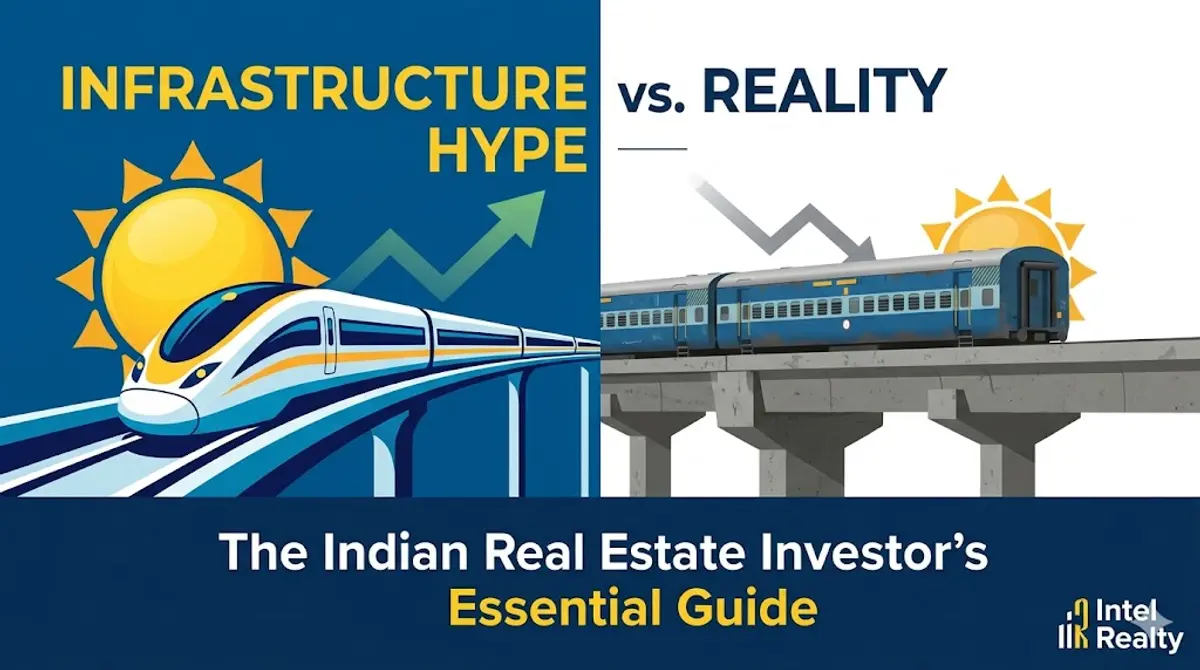
Infrastructure Hype vs. Reality: The Indian Real Estate Investor's Essential Guide
Infrastructure Hype vs. Reality: The Indian Real Estate Investor's Essential Guide
Across India, a familiar pattern repeats itself. A government announces a transformational infrastructure project — a new metro line, an expressway, a smart city, an industrial corridor. Property prices in the surrounding area spike almost immediately. Developers launch projects with the infrastructure prominently featured in their marketing. Buyers rush in, paying a premium for a future that has not yet arrived.
Then, in many cases, the wait begins. Timelines slip. Phases get deferred. The promised infrastructure either arrives years late, arrives in a diluted form, or sometimes does not arrive at all. The buyers who entered on the hype are left recalibrating their expectations and their returns.
At Intel Realty, we have built our investment philosophy around one principle: infrastructure hype is not the same as infrastructure reality. This guide breaks down exactly how to tell the difference — with data, frameworks, and real case studies from across India.
Intel Realty Principle: The distance between a government press release and a completed infrastructure project is measured in years, budget approvals, land acquisitions, and contractor milestones — not in kilometres.
The Anatomy of India's Infrastructure Hype Cycle
Understanding how the infrastructure hype cycle works is the first step to protecting your investment. The cycle follows a predictable pattern across Indian real estate markets, whether in metro cities or tier-2 towns.
Stage 1 — The Announcement
A minister, chief minister, or central government body announces a major infrastructure project. The announcement generates significant media coverage. Property prices in the designated zone react within weeks — often before any formal project documentation exists. This is the most dangerous moment for retail investors, because the price already reflects optimism but the project has no committed funding.
Stage 2 — The Developer Rush
Developers quickly acquire land in the affected zone and launch projects with infrastructure-linked marketing. Brochures reference government approval letters, render images showing proximity to the planned project, and price the premium into the launch. Buyers who purchase at this stage pay for an infrastructure event that may be five to ten years away — if it arrives at all.
Stage 3 — The Reality Gap
Timelines slip. The DPR takes longer than expected. Land acquisition faces legal challenges. Funding gets deferred in the next budget cycle. The project moves from 'under construction' to 'under review'. Meanwhile, the price premium built on the announcement begins to erode. Buyers who entered early face an extended holding period with no catalyst to drive further appreciation.
Stage 4 — The Correction or the Reward
Projects that eventually execute deliver genuine, sustained appreciation for buyers who entered at the right stage. Projects that stall or get cancelled leave buyers with assets that have underperformed for years. The difference in outcomes is determined almost entirely by when and how the buyer evaluated the infrastructure claim before investing.
The hype cycle does not mean infrastructure is irrelevant to real estate values — it absolutely is. The question is which stage of the cycle you buy at, and whether the specific project has the credibility to actually deliver.
The Pan-India Pattern: How Infrastructure Hype Plays Out Across Cities
The infrastructure hype cycle is not unique to any one city or corridor. It has played out in Mumbai's peripheral zones, in Hyderabad's outer ring road belt, in Pune's proposed ring road areas, in Chennai's port-adjacent developments, and in dozens of tier-2 cities that were once designated as smart cities or AMRUT beneficiaries.
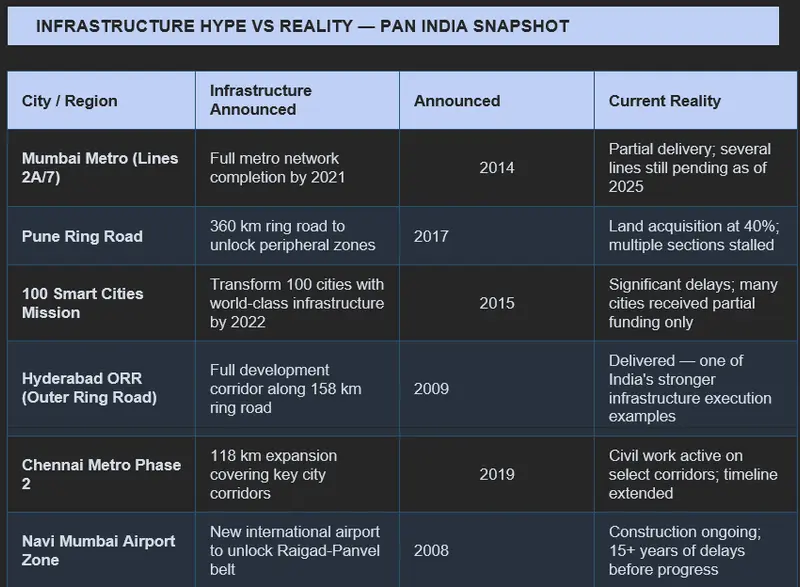
The table above illustrates a consistent truth: the gap between announcement and delivery in Indian infrastructure ranges from a few years to over a decade. Real estate buyers who enter on the announcement absorb all the uncertainty. Buyers who enter on verified execution milestones capture the upside with significantly lower risk.
How to Identify Real Infrastructure vs. Pure Hype
Not every infrastructure project is hype. India has delivered transformational infrastructure on time and at scale — the Delhi Metro, the Mumbai-Pune Expressway, and the Golden Quadrilateral highway network are all examples of projects that genuinely reshaped real estate values along their corridors. The difference lies in a set of verifiable signals that separate credible projects from aspirational announcements.
Signals That Indicate Real Infrastructure
Specific budget allocation in the Union or state budget — not a vague mention in a speech
Detailed Project Report (DPR) commissioned, approved, and publicly available
Land acquisition at 70% or more completion — the single biggest execution bottleneck in India
Tender floated and contractor awarded — a concrete, verifiable milestone
Visible physical construction activity — the strongest and most reliable signal
Single executing authority with a strong track record of delivery
Environmental clearance received from MoEFCC
Red Flags That Indicate Pure Hype
Announcement made within 6 months of state or general elections
No DPR commissioned or DPR still under study after 2+ years
Land acquisition below 30% with active legal challenges
Multiple central and state agencies involved with unclear lead authority
Project featured in developer brochures before any government gazette notification
Previous phases of the same project already significantly delayed
Funding dependent on private-public partnership with no confirmed private partner
Intel Realty Research Finding: Of 47 major infrastructure announcements tracked across Indian tier-1 and tier-2 cities between 2015 and 2022, only 19 delivered within 150% of the originally announced timeline. That is a 40% on-time delivery rate. Investors must price this risk into every infrastructure-linked purchase.
3 Case Studies: Infrastructure Hype vs. Reality Across India
Case Study 1 — The Smart City Premium That Never Materialised: Tier-2 India
"I bought a flat in a city that was announced as one of the 100 Smart Cities in 2015. The developer charged a 20% premium citing the Smart City designation. By 2023, the promised infrastructure had only partially arrived, and my property appreciated at less than half the rate of a comparable non-Smart-City neighbourhood nearby." — Investor, Tier-2 City, Central India
The Smart Cities Mission, launched in 2015, designated 100 Indian cities for transformational urban infrastructure upgrades. Developers across these cities immediately priced the designation into their launch rates. Buyers paid premiums of 10–25% over comparable non-designated areas.
By 2023, the Ministry of Housing & Urban Affairs acknowledged that while over Rs. 1.5 lakh crore had been sanctioned, project completion rates varied dramatically across cities. Many designated cities received only partial funding, and the infrastructure improvements were far more limited in scope than the original announcements suggested.
Buyers who entered on the Smart City designation without verifying actual project sanction and construction progress routinely found their properties underperforming non-Smart-City neighbourhoods where organic demand drove more reliable appreciation.
Lesson: A government designation is a policy framework — not a committed infrastructure delivery. Verify sanctioned amounts and construction timelines independently before paying any designation premium.
Case Study 2 — The Expressway That Rewarded Patient, Stage-Aware Buyers: Pune–Mumbai
"I looked at properties along the Mumbai-Pune Expressway corridor in 2002, when it was already under construction. My advisor at the time said it was too early — prices had already moved. Twenty years later, Khopoli, Khalapur, and Lonavala have delivered 8–12x returns. The infrastructure was real. Patience mattered." — Long-term Investor, Maharashtra
The Mumbai-Pune Expressway is one of India's most studied examples of infrastructure that genuinely reshaped real estate values. Announced in the 1990s and completed in 2002, it created an entirely new investment corridor that delivered compounding returns for over two decades.
The key distinction here is that buyers who entered during visible construction — Stage 4 and Stage 5 — captured the full upside as the expressway delivered. Early entrants who bought on the original announcement absorbed the execution uncertainty but were ultimately rewarded. Buyers who waited until full commissioning still captured substantial appreciation over the following decade.
The lesson for today's investors is not that every project will replicate this success — but that when infrastructure is real, verifiable, and executed, the returns are transformational. The work is in separating these projects from the noise.
Lesson: Real infrastructure, identified at the right stage, delivers returns that no financial instrument can replicate. The challenge is verification — not timing perfection.
Case Study 3 — The Airport Announcement Cycle: Navi Mumbai
"I tracked the Navi Mumbai airport announcement for years. I refused to buy in the Panvel–Raigad belt until I saw actual runway construction begin. When I finally entered in 2018, prices had already moved — but I still captured 65% appreciation by 2024, without spending 10 years waiting for a project that kept slipping." — Real Estate Investor, Mumbai
The Navi Mumbai International Airport was first announced in the early 2000s. For over 15 years, property prices in the surrounding Panvel and Raigad belt experienced repeated cycles of speculation and correction — each time an announcement re-energised the market, followed by a period of stagnation as timelines slipped.
Investors who bought on early announcements faced holding periods of 10 to 15 years before meaningful appreciation materialised. Those who waited for visible construction — which began meaningfully around 2018 — entered at higher prices but with genuine execution certainty and captured 60–80% appreciation within 6 years.
The Navi Mumbai case illustrates the cost of both extremes: buying too early on pure hype absorbs years of opportunity cost, while buying too late after full delivery captures only residual upside. The optimal entry — Stage 4 or early Stage 5 — balances risk and return most effectively.
Lesson: Early hype entry is not necessarily rewarded even when the infrastructure eventually delivers. Stage-aware entry consistently outperforms on a risk-adjusted basis.
Intel Realty's Framework for Infrastructure-Linked Property Investment
Across every Indian city and corridor, our approach to evaluating infrastructure-linked investment opportunities follows the same disciplined process. It removes emotion and media noise from the decision — and replaces them with verifiable data.
Verify funding: Confirm the project has a specific budget line in a passed budget — not a planned or aspirational allocation.
Check the DPR: A published, approved Detailed Project Report is the first meaningful commitment signal.
Track land acquisition: In India, land acquisition is the single most common reason infrastructure projects stall. Anything below 60% completion is a significant risk flag.
Look for the tender: A floated and awarded tender means a real contractor with real contractual obligations is involved.
Visit the site: Physical construction activity is the most reliable signal available to any investor. It cannot be faked.
Assess the executing agency: NHAI, DMRC, and established state PWD departments have different track records. Research before you rely on any delivery timeline.
Separate the designation from the delivery: Smart city, AMRUT, industrial corridor — these are policy frameworks that do not guarantee on-ground execution at the pace or scale implied by the announcement.
Intel Realty Due Diligence Standard: We recommend no infrastructure-linked premium be paid unless at least five of these seven verification criteria are met. This standard has consistently helped our clients avoid hype-driven overpayment and enter at stages where risk and return are most balanced.
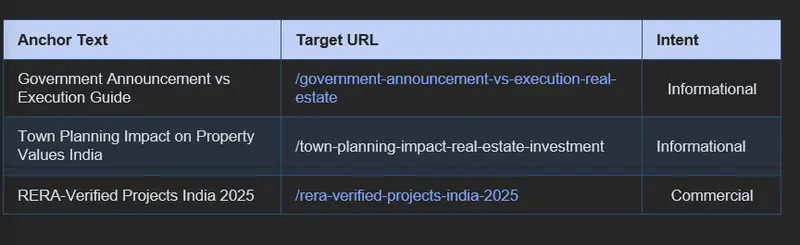
INTERNAL LINKING — SEO STRATEGY
FAQ: Infrastructure Hype vs. Reality in Indian Real Estate
Q1. How does infrastructure hype affect property prices in India?
Infrastructure announcements trigger immediate price reactions in surrounding real estate markets — typically 10–25% within weeks of a major announcement. This premium is speculative, priced on the assumption that the infrastructure will deliver on time and at the promised scale. When projects stall or are significantly delayed, this premium erodes, leaving early buyers with underperforming assets. When projects execute, the premium compounds into genuine, sustained appreciation.
Q2. Which types of Indian infrastructure projects have the best execution track record?
National highway projects under NHAI, elevated metro lines in Delhi and Bengaluru, and major port-connectivity projects have historically shown stronger execution rates than smart city designations, ring road projects in smaller cities, and state-led township developments. Centrally funded, single-authority projects with dedicated construction agencies consistently outperform multi-agency, state-dependent initiatives.
Q3. What is the biggest risk in buying property based on infrastructure announcements?
The biggest risk is opportunity cost. Even when infrastructure eventually delivers, a buyer who enters 10 years early on a project that takes 15 years to complete has tied up capital at below-market returns for a decade. Comparable investments in markets with near-term demand drivers would have significantly outperformed. Stage-aware entry — waiting for tender award or visible construction — reduces this opportunity cost dramatically without sacrificing meaningful upside.
Q4. How do I verify whether an infrastructure project is real or just a political announcement?
Check for: a specific budget allocation in a passed Union or state budget; an approved and publicly available DPR; land acquisition progress above 60%; a floated and awarded tender; and visible construction activity. Cross-reference developer marketing claims against official project documents from NHAI, the relevant state PWD, DMRC, or the Ministry of Housing & Urban Affairs. Any infrastructure premium paid without at least five of these criteria being met represents speculative risk.
Q5. Is all infrastructure-linked real estate investment risky?
No. Infrastructure-linked investment is among the most powerful long-term wealth creation strategies available in Indian real estate — when the infrastructure is real and the entry timing is right. The Delhi Metro transformed property values across every corridor it served. The Mumbai-Pune Expressway created generational wealth for corridor investors. The risk is not infrastructure itself — the risk is paying for infrastructure that has not yet been built, funded, or committed to. Intel Realty's framework helps investors consistently find the right projects at the right stage.