
INFRASTRUCTURE TIMING STRATEGY
INFRASTRUCTURE TIMING STRATEGY
Infrastructure Timing Strategy: How to Enter India's Best Investment Corridors at the Right Moment
Getting the location right is only half the work. The other half — the half that separates ordinary returns from exceptional ones — is getting the timing right. In India's infrastructure-driven real estate market, the same location can deliver a 3x return or a 1.3x return depending entirely on which stage of the infrastructure lifecycle you entered.
Infrastructure timing strategy is the discipline of systematically identifying the optimal entry point in an infrastructure project's lifecycle — balancing execution risk against remaining appreciation potential. It is neither reckless early entry nor cautious post-commissioning buying. It is a structured, evidence-based approach to finding the window where risk and reward align most powerfully.
This guide presents Intel Realty's complete infrastructure timing framework — the five stages, the signals that define each, the timing matrix, and three case studies that show how this strategy has delivered measurable outperformance across Indian real estate markets.
The Five-Stage Infrastructure Lifecycle — And Where Timing Matters Most
Every infrastructure project in India — whether metro rail, expressway, industrial corridor, or airport — passes through five distinct stages. Each stage carries a different risk profile and a different residual appreciation opportunity. Timing your entry correctly requires knowing which stage a project is in and what signals define that stage.
1 STAGE
Political Announcement
A minister or government body announces the project. No funding is committed and no DPR exists. Media coverage peaks here, creating speculative demand and price spikes of 10–20% in surrounding areas.
Risk: Very High|Residual Return Potential: 8x–15x|Recommended Action: Research Only
2 STAGE
DPR & Feasibility Approval
Detailed Project Report commissioned and approved. Project is credible on paper. Land acquisition process begins. First institutional investors and sophisticated buyers start positioning.
Risk: High|Residual Return: 5x–9x|Recommended Action: Watchlist + Prepare
3 STAGE
Land Acquisition & Environmental Clearance
Land acquisition progresses toward 60–80% completion. Environmental clearance received. Project is now highly likely to deliver, but timeline remains uncertain.
Risk: Moderate|Residual Return: 3x–5x|Recommended Action: Selective Early Entry
4 STAGE
Tender Award & Visible Construction
Contractor selected and on site. Physical construction activity is visible. Execution risk is effectively eliminated. The market has partially re-rated but significant upside remains.
Risk: Low|Residual Return: 2x–3.5x|Recommended Action: INTEL REALTY PREFERRED ENTRY
5 STAGE
Commissioning & Operational
Infrastructure is fully open and operational. Step-change re-rating complete. Appreciation continues through corridor maturation but first-mover premium is no longer available.
Risk: Very Low|Residual Return: 1.4x–2.2x|Recommended Action: Select Specific Pockets Only
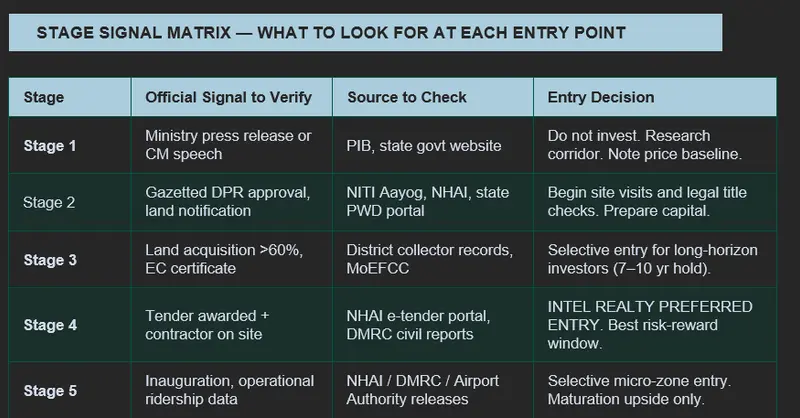
The Infrastructure Timing Matrix — Reading the Right Signals
Knowing which stage a project occupies requires reading the right signals at each level. These are not newspaper headlines — they are verifiable data points available in public government records.
Zone Timing: Where Within the Corridor You Enter Matters as Much as When
Infrastructure timing strategy is not only about when you enter relative to project lifecycle — it is also about where within the corridor you enter. Zone selection and timing work together to determine the full return profile.
HIGH PRIORITY ZONES
Expressway interchange zones (2–5 km radius)
Metro station walkable zone (0–500m)
Industrial node buffer zones (1–3 km)
Airport accessibility corridors (10–20 km)
TOD-notified mixed-use zones
These zones consistently capture 70–80% of total corridor appreciation.
LOWER PRIORITY ZONES
Mid-corridor sections with no nearby interchange
Beyond 1 km from metro station, no feeder
Industrial buffer zones with no residential plan
Speculative launches citing future corridor extensions
Areas dependent on private vehicle access only
These zones can still appreciate — but typically at half the corridor average.
3 Case Studies in Infrastructure Timing Strategy
01 Bengaluru Metro Phase 2 — Stage 4 Entry, 31% in 18 Months
CLIENT VOICE
We entered the Bengaluru ORR corridor 18 months before metro commissioning. Intel Realty identified Stage 4 signals — tender awarded, civil piling visible at three station sites. By commissioning, our entry price had appreciated 31%. We held through the first 12 months of operations for another 14%. — Tech Professional, Bengaluru
The Bengaluru Metro Phase 2 corridor — particularly the Outer Ring Road stretch connecting Whitefield and Marathahalli — provided a textbook Stage 4 entry case. When Intel Realty confirmed tender awards for multiple station packages and visited sites to verify active construction in mid-2021, the market had only partially priced in the connectivity change. Properties within 600 metres of planned stations were still priced 15–20% below comparable locations on the already-operational Purple Line.
Investors who entered in this Stage 4 window captured 31% appreciation by commissioning and a further 14% in the first post-commissioning year as ridership grew and the market fully re-rated. Total return: 45% in 30 months. Comparable late entrants who waited for commissioning captured only the 14% maturation phase.
KEY TAKEAWAYStage 4 entry captures both the commissioning uplift AND the maturation appreciation. Post-commissioning entry captures only the latter.
02 Mumbai–Nagpur Samruddhi Expressway — Stage 3 Entry, 5x in 7 Years
CLIENT VOICE
I entered the Nagpur-end corridor in 2018, when land acquisition was at 72% and the project was clearly going to deliver. My advisor at Intel Realty said Stage 3 entry on a NHAI project of this scale was acceptable if you had a 7-year horizon. Seven years later the numbers have proven that view correct. — Long-horizon investor, Maharashtra
The Samruddhi Expressway (Hindu Hrudaysamrat Balasaheb Thackeray Maharashtra Samruddhi Mahamarg) was one of India's largest expressway projects — 701 km connecting Mumbai to Nagpur. Land acquisition progress crossed 70% by 2018, environmental clearance was in hand, and NHAI contractor packages were being finalised. For investors with a 7–10 year horizon, this represented a Stage 3 entry opportunity with strong credibility signals.
Land parcels within 3 km of key interchange points on the Nagpur end — where industrial and logistics demand was concentrated — were available at Rs. 800–1,200 per square yard in 2018. By 2025, with the expressway fully operational and multiple logistics parks commissioned nearby, the same parcels were trading at Rs. 4,200–5,500 per square yard. Investors who entered Stage 3 with conviction and patience achieved returns of 4.5x to 5.5x over the holding period.
KEY TAKEAWAYStage 3 entry on a high-credibility NHAI project requires a long horizon — but the return per year of patience significantly exceeds Stage 4 or 5 entry.
03 Delhi–Meerut RRTS — Stage 4 Timing Outperforms Adjacent Metro
CLIENT VOICE
Intel Realty helped me compare the Delhi Metro extension and the RRTS corridor in the same geography. The metro was already operational — Stage 5. The RRTS was at Stage 4. Same distance from Delhi, same catchment. Different entry stages, very different return profiles available. I went with the RRTS corridor. — NCR Investor, Ghaziabad
The Rapid Rail Transit System (RRTS) Delhi-Meerut corridor presented a direct comparison opportunity with the adjacent Delhi Metro Blue Line extension in the same geographic zone. The metro extension was already operational (Stage 5), with prices fully reflecting the connectivity change. The RRTS — a separate, higher-speed corridor — was at Stage 4: contractor on site, visible construction at multiple stations, commissioning 18 months away.
Investors who chose the Stage 4 RRTS corridor over the Stage 5 metro zone entered at 18–22% lower prices for comparable properties in the same commute radius. By the time the first RRTS sections opened in 2023, those properties had appreciated 28–35%. The metro-adjacent properties — already Stage 5 priced — appreciated 8–12% over the same period. The timing of entry, not the infrastructure itself, drove the differential.
KEY TAKEAWAYWhen two infrastructure events serve the same geography, always compare entry stages, not just connectivity quality. Stage 4 consistently outperforms Stage 5 on a risk-adjusted return basis.
Your Infrastructure Timing Strategy Checklist
Before committing capital to any infrastructure-linked property in India, work through this checklist. It is the same process Intel Realty uses for every corridor recommendation we make.
PROJECT CREDIBILITY
Confirm budget line in passed Union/state budget
Verify DPR approved and publicly available
Check land acquisition progress (60%+ = credible)
Confirm environmental clearance received
Verify agency delivery track record
ZONE & ASSET SELECTION
Map distance to interchange or station precisely
Verify last mile infrastructure quality
Assess approved supply pipeline within 1 km
Identify secondary catalysts on the corridor
Verify RERA registration and title independently
INTEL REALTY STANDARD
A property must meet at least 8 of these 10 criteria before we classify it as a timing-optimised, infrastructure-linked investment opportunity. Partial compliance means partial risk — and partial returns.
FAQ: Infrastructure Timing Strategy in Indian Real Estate
Q1—What is infrastructure timing strategy in real estate?
Infrastructure timing strategy is the discipline of identifying the optimal moment in an infrastructure project's lifecycle — from announcement through commissioning and maturation — to enter a property investment. It balances execution risk (the probability that the project will actually deliver) against residual appreciation potential (how much value the market has not yet priced in). The goal is to find the window where risk is low and upside is high — Intel Realty's research places this consistently at Stage 4: tender awarded, with visible construction activity.
Q2—When is the best time to invest in infrastructure-linked real estate in India?
The Stage 4 window — when a contractor has been awarded and physical construction is visible on site — consistently offers the best risk-adjusted entry point across Indian infrastructure corridors. At this stage, execution risk is near-eliminated, the commissioning timeline is credible (typically 12–24 months away), and the market has only partially priced in the connectivity change. Investors at Stage 4 capture the commissioning uplift, the first-year operational re-rating, and the subsequent corridor maturation — typically the three largest consecutive appreciation phases.
Q3—How do I determine which stage an infrastructure project is at?
Stage can be determined from publicly available official sources. For central projects: check NHAI e-tender portal for contractor awards, Ministry of Road Transport & Highways for progress reports, DMRC for civil work updates, and NITI Aayog project dashboards for DPR status. For state projects: check state PWD portals, district collector land acquisition notifications, and state government gazette notifications. Physical site visits — where construction activity is directly observable — are the most reliable Stage 5 confirmations. Intel Realty combines all these data sources into a unified corridor status assessment.
Q4—Does infrastructure timing strategy apply to all property types?
Yes, but differently by asset type. Plotted land and agricultural land near interchanges benefit most from early-stage (Stage 2–3) entry because the re-rating from agricultural to development land is a step-change event. Residential apartments in established cities are best entered at Stage 4 to avoid the execution risk of a 5+ year hold with no rental income. Commercial and industrial properties often benefit from Stage 3 entry when industrial demand can be confirmed through secondary signals before the residential market reacts. Intel Realty tailors stage-entry recommendations to the specific asset type and investor holding capacity.
Q5—How does Intel Realty identify infrastructure timing opportunities across India?
Intel Realty tracks 18 active infrastructure corridors across 14 Indian cities through a combination of official data monitoring (NHAI, DMRC, Ministry portals), physical site visits by our research team, industrial land absorption tracking, and institutional investor activity signals. We apply our 5-stage classification to each corridor monthly and update our recommended entry windows accordingly. When a corridor moves from Stage 3 to Stage 4 — the signal that most consistently precedes optimal entry — we alert relevant clients before the transition becomes widely visible in the market.