LOGISTICS HUBS & LAND DEMAND
LOGISTICS HUBS & LAND DEMAND
Logistics Hubs and Land Demand: India's Most Underappreciated Real Estate Story
India's logistics sector is undergoing a once-in-a-generation transformation. The combination of GST unification, the PM Gati Shakti National Master Plan, the Dedicated Freight Corridor network, e-commerce growth, and post-pandemic supply chain restructuring has compressed two decades of logistics modernisation into less than five years. The result is a surge in demand for land — specifically, large, well-connected, infrastructure-enabled land parcels suitable for Grade-A warehousing and logistics parks.
This land demand is reshaping real estate values across India's industrial belts, peripheral urban zones, and freight corridor adjacencies with a speed and consistency that has surprised even experienced industrial property investors. Land that was priced as agricultural or low-grade industrial in 2019 is now commanding 2 to 4 times those prices — driven not by speculative sentiment but by genuine, institutionally-funded occupier demand from e-commerce platforms, FMCG companies, pharmaceutical manufacturers, and third-party logistics operators.
At Intel Realty, we have tracked logistics-driven land demand across India as one of the highest-conviction real estate themes of the decade. This guide explains the demand drivers, the geography of opportunity, and how investors can position ahead of the next wave before the broader market catches up.
INTEL REALTY RESEARCH
Between 2019 and 2024, land within 10 km of a Grade-A logistics hub or multi-modal logistics park in India appreciated an average of 2.6 times the benchmark for comparable industrial land in the same district. In high-demand corridors like Bhiwandi, Ludhiana, and Hosur, appreciation exceeded 3.5 times the district average.
Why Logistics Land Demand Is Surging Across India Right Now
The logistics land demand story is not simply about warehousing growing. It is about a fundamental restructuring of India's supply chain geography — driven by four converging forces that are creating new demand faster than the market can supply appropriate land.
Force 1 — GST and Supply Chain Rationalisation
Before GST, India's warehousing was fragmented by state-level tax incentives — companies maintained small, sub-optimal warehouses in every state to avoid interstate tax complications. Post-GST, the optimal supply chain consolidates into fewer, larger, better-located distribution centres that can serve multiple states efficiently. This consolidation is driving demand for large-format, well-connected land parcels near national transport nodes — and the land absorption has been sustained and growing since 2017.
Force 2 — E-Commerce and Quick Commerce Expansion
India's e-commerce sector — led by Amazon, Flipkart, Meesho, and a rapidly growing quick commerce segment including Blinkit, Zepto, and Swiggy Instamart — requires a dense network of fulfilment centres, dark stores, and regional distribution hubs. Quick commerce's promise of 10-minute delivery requires urban dark stores within 2 to 3 km of customer density — creating a new category of logistics land demand that is geographically different from traditional warehousing but equally powerful in its price impact on land near urban population centres.
Force 3 — PM Gati Shakti and Multi-Modal Logistics Parks
The PM Gati Shakti National Master Plan has catalysed logistics infrastructure investment at a scale India has not seen before. The plan's 109 Multi-Modal Logistics Parks (MMLPs) — being developed at identified nodes across the national highway and freight corridor network — are creating concentrated demand for surrounding land. Land near announced and operational MMLPs has already seen 30 to 60% appreciation in many locations as developers and logistics operators compete for the best-connected parcels.
Force 4 — Global Supply Chain Restructuring (China+1)
Global manufacturers diversifying away from China-centric supply chains — the so-called China+1 strategy — are evaluating India as a manufacturing and logistics base for exports to Western markets. Apple, Samsung, Foxconn, and dozens of their supplier ecosystem companies are establishing manufacturing in India — each creating demand for local supply chain infrastructure, component warehousing, and finished goods distribution. This institutional manufacturing demand is different in character from domestic e-commerce demand — it requires proximity to ports, airports, and bonded logistics zones.
The Geography of Logistics Land Demand Across India
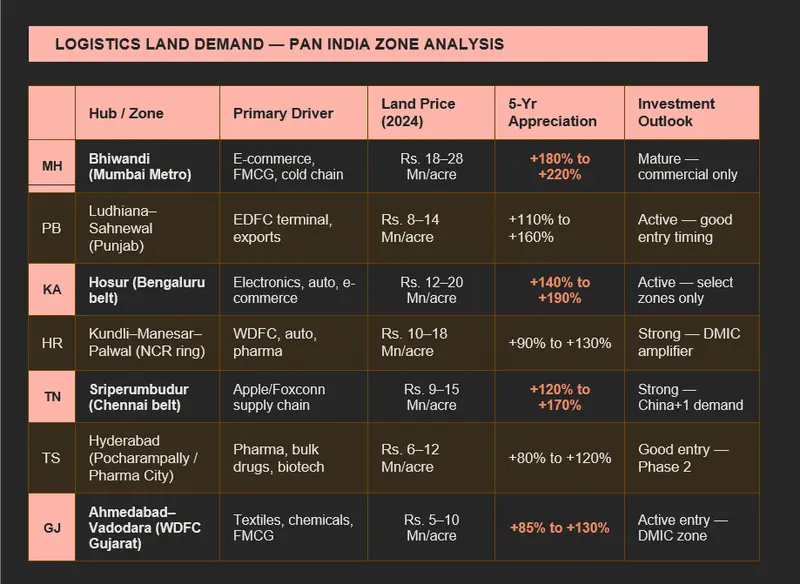
Logistics land demand is not uniform across India. It concentrates in specific geographic clusters that offer the combination of connectivity, infrastructure, and land availability that large-format logistics operations require. Understanding this geography is the essential first step in identifying the right investment zones.
What Makes a Location Attract a Logistics Hub — And Drive Land Demand
Not every location can become a logistics hub. The locations that attract Grade-A warehouse development and sustained institutional occupier demand share a specific set of characteristics. Understanding these characteristics helps investors identify the next tier of logistics land appreciation before it becomes widely recognised.
ESSENTIAL LOCATION FACTORS
Within 30 km of a major consumption centre or port
National highway or DFC terminal connectivity within 5 km
Minimum 5–50 acre contiguous land availability
Reliable 3-phase power with 33 kV or higher grid connectivity
Industrial zoning designation from state authority
Adequate floor space index (FSI) for high-bay warehousing
Locations meeting 5+ of these criteria attract Grade-A development within 3 to 5 years of identification.
DEMAND AMPLIFIERS
MMLP designation under PM Gati Shakti — government anchor
DFC terminal within 10 km — rail freight cost advantage
Proximity to airport — air cargo and time-sensitive supply chains
Industrial anchor occupier already established in the zone
Cold chain or pharma-specific infrastructure in place
Special Economic Zone (SEZ) or bonded logistics zone designation
Each amplifier adds 15 to 30% to land appreciation potential above the baseline hub value.
3 Case Studies: Logistics Hubs Driving Land Returns Across India
01
Bhiwandi — From Cotton Town to India's Biggest Logistics Cluster
CLIENT VOICE
"I bought industrial land in Bhiwandi in 2016 when it was still dominated by power looms. A friend who worked in logistics told me that three e-commerce companies were quietly acquiring large parcels nearby. I paid Rs. 6.2 Mn per acre. The same land is now quoted at Rs. 22 Mn. The e-commerce signal was all I needed." — Industrial Land Investor, Maharashtra
Bhiwandi — 35 km from Mumbai — has undergone one of the most dramatic logistics-driven land transformations in Indian history. A century-old textile town with declining power loom industry, Bhiwandi sat on a geographic sweet spot: proximity to JNPT, Mumbai city consumption, national highway access, and large flat land parcels that aging textile mills were selling off at distressed prices.
Amazon, Flipkart, Delhivery, Blue Dart, and over 150 logistics operators recognised this geography before the mainstream real estate market did. Between 2015 and 2023, over 120 million square feet of Grade-A warehouse space was developed or committed in the Bhiwandi-Thane belt — creating the largest single logistics cluster in South Asia. Land that was available at Rs. 5 to 7 Mn per acre in 2015 is now trading at Rs. 20 to 28 Mn per acre for residual undeveloped parcels. Bhiwandi is now substantially priced in — but it provides the clearest roadmap for identifying the next tier of logistics-driven land appreciation.
KEY TAKEAWAYThe early signal for Bhiwandi was not developer launches — it was logistics operator land acquisition. Tracking where institutional logistics tenants are acquiring land, not where developers are launching projects, is the most reliable leading indicator of logistics-driven land appreciation.
02
Hosur — Electronics Manufacturing Creates India's Fastest-Rising Logistics Land Market
CLIENT VOICE
"Intel Realty flagged Hosur in 2020 as a logistics land opportunity driven by the Tamil Nadu electronics manufacturing policy. At the time, Foxconn was just beginning its Apple iPhone production nearby. I entered at Rs. 9 Mn per acre. By 2024 the same land is at Rs. 21 Mn. The China+1 strategy was the thesis — and it delivered." — Land Investor, Tamil Nadu
Hosur — 35 km from Bengaluru on the Tamil Nadu border — has emerged as India's fastest-rising logistics land market, driven by the concentration of electronics manufacturing that has made it India's primary iPhone production zone. Foxconn, Tata Electronics, Jabil Circuit, and their supplier ecosystem have established a manufacturing cluster that requires both inbound component logistics (imports via Chennai Port and Bengaluru Airport) and outbound finished goods distribution.
The logistics land demand in Hosur is fundamentally different from the e-commerce-driven demand in Bhiwandi — it is driven by complex, time-sensitive manufacturing supply chains rather than consumer fulfilment. This makes the land demand more durable and less cyclical, because manufacturing supply chain requirements do not contract with consumer sentiment swings the way e-commerce fulfilment volumes can. Intel Realty identified Hosur as a high-priority logistics land investment in 2019 based on the electronics policy signals from the state government — before Foxconn's facilities became publicly visible. Land appreciation of 130 to 180% between 2019 and 2024 has validated this thesis.
KEY TAKEAWAYManufacturing supply chain logistics create more durable land demand than pure e-commerce fulfilment. When global anchor manufacturers establish facilities, the logistics land demand that follows is institutional, long-term, and resistant to cyclical correction.
03
Hyderabad Pharma City — Specialised Logistics Hub Creates Premium Land Market
CLIENT VOICE
"The Hyderabad Pharma City designation created a specialised logistics demand that regular industrial investors missed entirely. Cold chain warehousing, bulk drug storage, and temperature-controlled distribution — these are completely different infrastructure requirements from FMCG or e-commerce. I bought land near the Pocharampally pharma zone in 2018 at Rs. 4.5 Mn per acre. Current quote: Rs. 10.8 Mn." — Pharma Logistics Investor, Telangana
The Hyderabad Pharmaceutical City — India's largest pharma SEZ, spanning 19,000 acres near Hyderabad — has created a specialised logistics land market that standard logistics park developers and investors have largely overlooked. Pharmaceutical manufacturing requires temperature-controlled warehousing, cold chain logistics, bonded drug storage, and specialised API (Active Pharmaceutical Ingredient) handling infrastructure — creating demand for land that meets very specific technical specifications, commands premium rental rates, and attracts institutional long-term tenants.
Land near the Pharma City boundary zone — which offers proximity to the SEZ without its registration constraints — has appreciated steadily as third-party logistics operators have established specialised pharmaceutical distribution centres serving the manufacturing cluster. Rental yields for temperature-controlled pharma logistics assets in this zone run at 10 to 14% annually — among the highest in the Indian commercial real estate universe. Intel Realty has identified three similar pharma-logistics land opportunities in Andhra Pradesh and Gujarat that are currently at the pre-market-recognition stage that Hyderabad occupied in 2018.
KEY TAKEAWAYSpecialised logistics segments — pharma, cold chain, hazardous materials — create premium land demand that general logistics investors overlook. Identifying the specialised demand driver before the market recognises it consistently delivers outsized returns.
How to Invest in Logistics-Driven Land Demand Across India
Logistics land investment is most rewarding when you enter before the market has fully recognised the demand driver. Here is Intel Realty's framework for identifying and entering logistics land opportunities across India:
Track institutional logistics operator land acquisition: Monitor CBRE, JLL, and Knight Frank logistics market reports for new land acquisition announcements. When three or more Grade-A operators acquire in the same zone within 12 months, that zone is entering its appreciation cycle.
Follow MMLP designations: The government's list of 109 Multi-Modal Logistics Parks is publicly available. Land near confirmed and funded MMLPs with operational timelines within 3 years is at the optimal pre-appreciation entry point.
Identify DFC terminal zones: DFC terminal locations — which are publicly mapped by DFCCIL — create the strongest logistics land demand in their surrounding 10 km radius. Verify whether the terminal is operational or within 18 months of commissioning.
Assess specialised demand sectors: Beyond general warehousing, identify whether the zone has pharma, cold chain, automotive, or electronics manufacturing anchors. Specialised logistics demand commands higher rental rates and creates more durable land appreciation than general fulfilment.
Verify industrial zoning and FSI: Confirm that the land has industrial zoning designation and adequate FSI for high-bay warehousing construction. Land without industrial zoning cannot attract Grade-A developers regardless of location.
Compare rental yield to land acquisition cost: A logistics land investment that supports a Grade-A warehouse with rental yield of 9 to 12% represents genuine value. If current land prices already imply sub-6% yield on potential development cost, the appreciation opportunity has largely been captured.
Plan for a 5 to 7 year hold: Logistics land appreciation compounds as hub density grows. Early entry in a zone where 2 to 3 operators have arrived but 8 to 10 more will follow delivers returns that short-term exits cannot capture.
INTEL REALTY STANDARD
We recommend logistics land investment only when institutional operator absorption has been confirmed through independent market data, industrial zoning is verified from state authority records, and current rental yield economics support the acquisition price. Speculative logistics adjacency — without confirmed operator demand — does not meet our investment threshold.
FREQUENTLY ASKED QUESTIONS
FAQ: Logistics Hubs and Land Demand in Indian Real Estate
Q1—Why are logistics hubs driving land demand in India right now?
Four converging forces are driving logistics land demand in India simultaneously: GST-induced supply chain consolidation (companies optimising from multi-state mini-warehouses to fewer, larger, better-located distribution centres); e-commerce and quick commerce growth requiring dense fulfilment networks; PM Gati Shakti's 109 Multi-Modal Logistics Parks creating new demand anchors; and China+1 global supply chain restructuring attracting manufacturing that needs sophisticated logistics support. Together, these forces have created demand for Grade-A logistics land that is structurally larger than existing supply — creating a sustained appreciation environment that Intel Realty estimates will persist through at least 2028.
Q2—Which Indian cities offer the best logistics land investment in 2025?
Based on Intel Realty's 2025 zone analysis, the best current entry opportunities are: Ludhiana-Sahnewal (Punjab) — EDFC terminal, Grade-A warehouse yields of 9.5 to 12%, still reasonable land prices; Hosur (Tamil Nadu) — electronics manufacturing anchor demand, China+1 theme, land appreciation still compounding; Hyderabad Pharma Zone — specialised logistics, premium yields, pre-market-recognition stage in adjacent zones; and the WDFC Gujarat belt (Ahmedabad-Vadodara corridor) — DMIC amplifier, logistics park formation Phase 2. Bhiwandi is substantially mature — recommended for commercial logistics assets only, not land banking.
Q3—What is the difference between Grade-A and Grade-B warehousing, and why does it matter for land investment?
Grade-A warehousing features high-bay ceiling heights (typically 9 metres or more), dock-levellers for direct truck loading, fire suppression systems, 24/7 power supply, and professional park management. It commands rental premiums of 30 to 50% over Grade-B conventional warehousing and attracts institutional tenants including e-commerce leaders, FMCG multinationals, and third-party logistics operators. For land investors, Grade-A development potential — which requires specific land specifications including industrial zoning, adequate FSI, and road access — is the key differentiator. Land that can support Grade-A development commands 2 to 3 times the price of land limited to Grade-B use.
Q4—How does PM Gati Shakti impact logistics land values in India?
The PM Gati Shakti National Master Plan has designated 109 Multi-Modal Logistics Parks (MMLPs) across India's national highway and freight corridor network. Each MMLP designation creates a concentrated demand anchor — combining rail, road, and warehousing in a single planned facility — that attracts surrounding commercial logistics development. Land within 5 to 10 km of confirmed and funded MMLPs with operational timelines within 3 years is at the optimal pre-appreciation entry point. Intel Realty tracks all 109 MMLP sites, their funding status, and construction timelines to identify which are generating genuine land demand versus which are still in planning stage.
Q5—How does Intel Realty identify logistics land investment opportunities before the market does?
Intel Realty combines four data streams to identify logistics land opportunities before mainstream market recognition: institutional logistics operator land acquisition tracking (from CBRE, JLL, and Knight Frank quarterly reports); DFCCIL terminal operational status monitoring; state government MMLP and industrial park designation tracking; and manufacturing sector anchor investment signals (Ministry of Commerce investment approvals, Electronics Policy state notifications, Pharma-SEZ designations). When three or more of these signals converge in a geographic zone, Intel Realty classifies it as a high-priority logistics land opportunity and begins active due diligence for client positioning — typically 18 to 36 months before the zone appears in mainstream media as an investment story.