New Gurgaon Sectors 82-95: Next Institutional Capital Hub?
The Structural Re-Centering of Gurugram
The landscape of Gurugram’s real estate market has reached a critical evolutionary milestone. The hyper-speculative era defined by unprecedented 20% to 25% annual price spikes has systematically transitioned into a period of infrastructure-backed price stabilization and structural maturity. As established micro-markets such as Golf Course Road and Golf Course Extension Road approach physical saturation and cross extreme luxury pricing benchmarks, global funds, domestic Alternative Investment Funds (AIFs), and institutional asset managers are widening their scope.
The central question dominating corporate boardrooms is clear: Is it finally time for large scale institutional capital to move west toward New Gurgaon, specifically the corridor spanning Sectors 82 to 95?
Historically categorized as a mid-segment or affordable housing destination, this micro-market is undergoing a profound structural re-centering. Backed by the operational integration of the Dwarka Expressway, the systemic enforcement of the Haryana Real Estate Regulatory Authority (HRERA), and the proximity to the massive 1,000-acre Global City project, New Gurgaon is migrating from an entry-level residential fallback to a institutional-grade investment engine. This comprehensive analysis deconstructs the macroeconomic drivers, granular sector clusters, asset pricing models, and risk parameters shaping the institutional investment thesis for Gurugram’s western expansion.
The Macroeconomic Backdrop: India’s $4.5 Billion Institutional Inflow Surge
Institutional interest in Indian real estate is operating at a multi-year high. Domestic and international institutional inflows reached $4.5 billion during the first half of 2026, marking the highest volume in six years and reflecting a 50% year-on-year expansion. The National Capital Region (NCR), with Gurugram as its primary economic engine, has successfully captured a dominant share of this capital deployment.
This capital influx is heavily supported by a highly proactive regulatory framework. During the first six months of 2026, HRERA Gurugram approved 51 major real estate projects, representing an aggregate capital investment of nearly $4 billion (approximately ₹34,000 crore). Crucially, the concentration of capital is pivoting toward large-scale developments; just 11 mega-projects account for ₹25,000 crore of the total approved capital volume.
For global private equity firms, pension funds, and major domestic institutional asset managers, the primary challenge in Gurugram’s mature corridors is the lack of scalable land parcels with unencumbered titles. With traditional luxury zones seeing a visible inventory stabilization in properties priced above ₹6 Crore, the structural underwriting models of top-tier funds are identifying New Gurgaon as the next logical region capable of absorbing high-volume, institutional Grade-A developments.
Micro-Market Mapping: Decoupling Sectors 82 to 95
To accurately evaluate New Gurgaon’s capacity to absorb institutional capital, investors must look past the generic "New Gurgaon" label. This corridor consists of three distinct structural sector clusters, each possessing distinct pricing characteristics, occupancy dynamics, and infrastructure timelines.
The Advanced Transit Nodes (Sectors 82, 83, 84, 85)
This cluster serves as the immediate eastern gateway to New Gurgaon, functioning as the vital connection point between National Highway 48 (NH-48) and the Central Peripheral Road (CPR) / Dwarka Expressway loop.
- Occupancy & Development State: This zone exhibits high physical occupancy rates exceeding 75% across mature communities. It is characterized by established, large-scale township layouts developed by legacy entities like DLF (e.g., DLF Primus, DLF New Town Heights) and Vatika Group.
- Commercial Integration: The area is rapidly gaining commercial density, highlighted by structured mixed-use developments and high-footfall retail hubs such as Elan Imperial in Sector 82, which integrates retail, dining, and multiplex layouts into a singular destination.
- Institutional Viability: Highly viable. Premium developers like Ganga Realty are actively pushing the luxury envelope here with projects like Nandaka 84 and Anantam 85, providing a clear indication that affluent buyers and HNIs view these sectors as viable primary residences.
The High-Growth Residential Core (Sectors 89, 90, 91, 92)
Positioned slightly deeper into the western geographic layout, this cluster represents the core residential volume engine of New Gurgaon.
- Developer Ecosystem: This zone is highly institutionalized, featuring significant asset deployment from top corporate developers including Godrej Properties, Shapoorji Pallonji, and Signature Global.
- Structural Attributes: The grid-based sector layout provides wider internal arterial roads and more organized green space allocations compared to Gurugram’s older municipal zones. The projects here focus on the expanding "premium-affordable" and mid-segment categories, drawing strong end-user demand from professionals working in the nearby corporate districts.
The Extended Emerging Frontier (Sectors 93, 94, 95, 95A)
This cluster forms the outer western boundary of the micro-market, extending toward Pataudi Road and the outer industrial links.
- Market Dynamics: Characterized by newer launches, lower baseline land entry costs, and significant participation from regional developers alongside affordable housing champions like ROF and Signature Global.
- Investment Outlook: This zone requires a longer investment horizon. While capital appreciation potential remains high due to its long-term positioning near the upcoming KMP Expressway links and the external boundaries of the Global City blueprint, immediate institutional rental yields remain modest.
Data Analysis: Property Price Configurations & Rental Matrices
The financial viability of institutional capital deployment in Sectors 82-95 is directly tied to a highly competitive value proposition. While prime Golf Course Extension Road sectors trade at premium levels of ₹14,000 to ₹20,000 per square foot, New Gurgaon offers an attractive entry matrix that appeals to practical end-users and corporate renters alike.
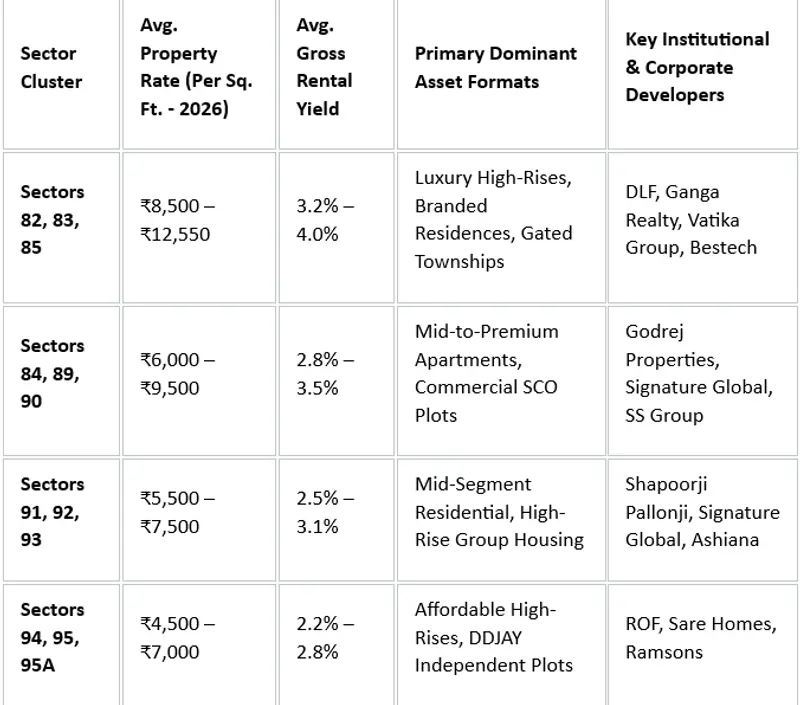
The following matrix provides a comprehensive overview of the pricing, performance, and asset formatting across the New Gurgaon sector clusters:
Key Takeaway from the Data
The data indicates a clear structural transition. Sectors like 82 and 85 have broken past the traditional mid-market ceiling, with prime projects touching over ₹12,500 per square foot. Gross rental yields in these highly populated sectors are stabilizing around the 3.5% to 4.0% mark, matching the performance of mature urban hubs while offering a more accessible capital entry barrier and a long-term capital appreciation trajectory.
The Five Structural Pillars Driving the "Move West"
Institutional capital does not move based on short-term speculative trends; it requires structural, long-term economic drivers. Five distinct pillars are accelerating the institutional migration toward New Gurgaon’s western corridors:
1. Complete Infrastructure Integration
The foundational risk previously associated with New Gurgaon was infrastructure execution delay. In 2026, this risk has been largely resolved. The full operational integration of the Dwarka Expressway, the Central Peripheral Road (CPR), and the Multi-Modal Cloverleaf flyover has changed connectivity dynamics. The micro-market now enjoys smooth, signal-free transit access to New Delhi, the Yashobhoomi International Convention Centre (IICC), and the Indira Gandhi International Airport (IGI), reducing transit times by up to 50%.
2. The Anchor Effect of the 1,000-Acre Global City
Positioned adjacent to the eastern boundary of the Sectors 82-95 cluster, the Haryana government's 1,000-acre Global City project serves as a massive economic anchor. Designed as a central business district featuring high-density commercial towers, international financial centers, and high-end retail zones, it is expected to generate massive high-income corporate employment. Institutional investors are proactively acquiring residential land parcels in surrounding sectors (specifically 82, 84, 85, and 89) to capture the anticipated demand wave.
3. High-ESG Mandates & The "Premiumization" Trend
Global institutional funds operate under rigid Environmental, Social, and Governance (ESG) criteria. Legacy developments in older parts of Gurugram often require extensive retrofitting to meet these global compliance standards. In contrast, the newer project blueprints in Sectors 82-95 are being designed as green-certified, sustainable assets from day one. Features such as solar energy arrays, EV charging infrastructure, modern water recycling systems, and efficient low-density layouts are standard in the latest project launches.
4. The End-User Driven Demand Profile
Unlike speculative real estate plays, the absorption pattern in New Gurgaon is anchored by practical end-users and long-term NRI investors. Home loan distributions and end-user data reveal that a significant percentage of buyers are corporate professionals seeking long-term residential security. This structural end-user baseline insulates institutional investors from the volatile boom-and-bust cycles typical of purely speculative, investor-heavy markets.
5. Proximity to the Manesar Industrial Nexus
Industrial Model Township (IMT) Manesar, located directly west of this corridor, stands as one of Northern India's most significant industrial and manufacturing hubs. Employing a vast management, engineering, and technical workforce, IMT Manesar generates a continuous, resilient demand loop for quality housing. The executive workforce is increasingly upgrading from basic configurations to the Grade-A gated high-rises found in Sectors 82-86, providing a highly reliable tenant pipeline for institutional rental assets.
Risk Assessment & Mitigations for Institutional Underwriters
While the macro indicators are positive, institutional capital deployment requires a careful evaluation of local market challenges:
- Shadow Inventory Cleansing: The secondary market across certain mid-segment sectors contains investor-held stock from the 2023-2024 launch cycles. Institutional funds entering the market must focus on offering distinct products—such as highly integrated branded residences or ultra-luxury configurations—to avoid competing directly with this secondary inventory.
- Micro-Market Infrastructure Imbalances: While primary highways are fully functional, certain internal sector roads and municipal utility grids in the outer Sectors (93-95) are still catching up. Capital deployment models should favor sector locations that possess verified connection lines to municipal trunk infrastructure.
- Title Verification Clarity: Despite strict HRERA oversight, reviewing localized land records and ensuring clear titles remains essential. Underwriters should prioritize established developers with a proven history of clean land aggregation and successful escrow account compliance.
FAQ Section
1. What differentiates New Gurgaon (Sectors 82-95) from the Dwarka Expressway micro-market?
While both corridors share excellent regional connectivity via the Dwarka Expressway, the Sectors 82-95 cluster features a more balanced mix of established residential townships and immediate access to both NH-48 and the IMT Manesar industrial hub. The Dwarka Expressway sectors (Sectors 102-113) sit closer to the Delhi border and command slightly higher entry prices, whereas the Sectors 82-95 cluster provides scalable land configurations at a more accessible capital value base.
2. How does the upcoming 1,000-acre Global City project directly impact real estate valuations in Sectors 82-95?
The Global City project is designed to serve as a world-class financial and commercial hub. As major corporate entities and global commercial tenants occupy this new business district, the demand for premium housing within a 5-to-10 minute transit radius will expand significantly. Sectors 82, 84, 85, and 89 are positioned to capture this demand, leading to solid capital appreciation and increased rental yields over the next 3 to 5 years.
3. What are the typical rental yields available for institutional or individual investors in New Gurgaon?
In 2026, mature sectors like Sector 82 and Sector 85 are delivering stable gross rental yields ranging between 3.2% and 4.0% for Grade-A residential layouts. This performance is highly competitive with Gurugram's traditional premium hubs. Additionally, select commercial assets and Shop-Cum-Office (SCO) plots within the broader corridor can achieve yields ranging from 7% to 9%, depending on their direct road visibility and footfall metrics.
4. Is there a risk of oversupply or a real estate bubble in New Gurgaon?
The current market data suggests stabilization rather than a speculative bubble. Unsold inventory levels across Gurugram dropped to a multi-year low of 18 to 20 months. Because recent development activity is driven by genuine end-user absorption rather than short-term speculative flipping, the risk of a sharp correction is well mitigated by steady long-term demand.
5. Why are global institutional funds prioritizing ESG-compliant developments in this corridor?
International institutional funds, including sovereign wealth funds and global pension boards, operate under strict regulatory and corporate sustainability mandates. They require investment assets to achieve top-tier green building certifications, low carbon footprints, and efficient waste management designs. New Gurgaon's modern project launches allow developers to integrate these high-ESG systems directly into the initial construction phase, making them highly attractive to institutional capital.