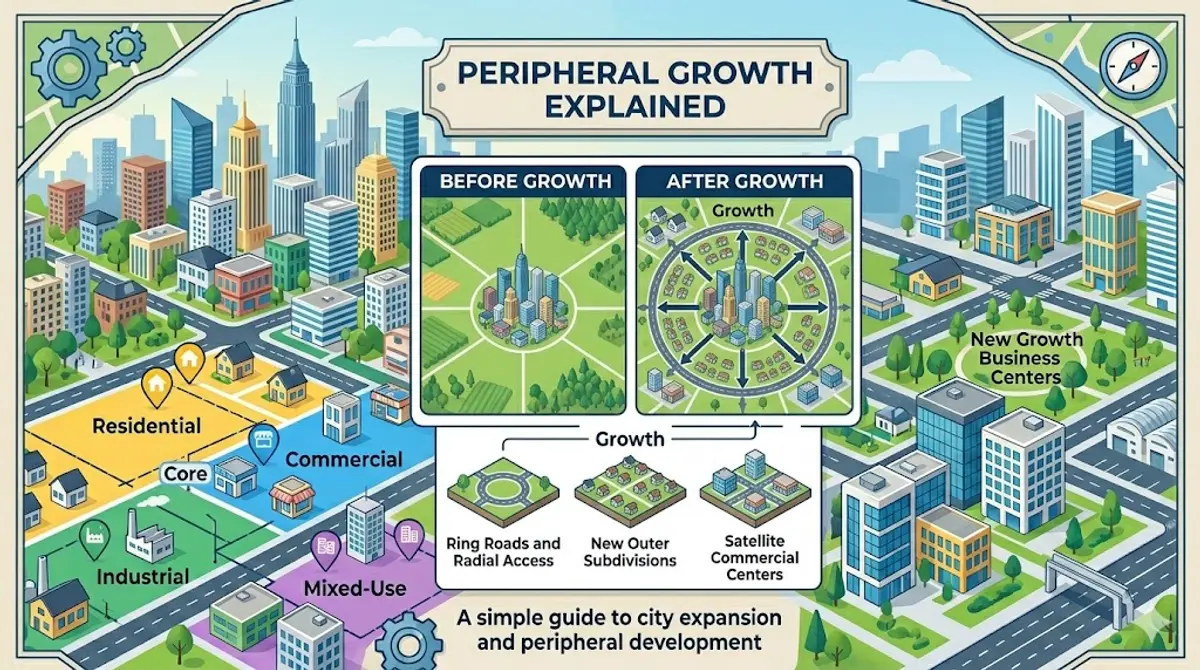
PERIPHERAL GROWTH EXPLAINED
PERIPHERAL GROWTH EXPLAINED
Peripheral Growth Explained: How India's Urban Expansion Is Creating Real Estate Wealth
India's major cities are full. Land in Connaught Place, Bandra, Koramangala, and Banjara Hills has reached prices that exclude the vast majority of buyers. Traffic in city centres is increasingly dysfunctional. The future of Indian real estate — and the location of the next decade's most significant property returns — is not in the urban core. It is on the periphery.
Peripheral growth is the process by which cities expand outward, extending their economic and residential footprint into zones that were previously agricultural, peri-urban, or semi-rural. This process is not new — it has driven the development of suburbs in every urbanising society in history. What is new in India today is the scale, the speed, and the infrastructure investment that is enabling and accelerating this expansion simultaneously across 15 to 20 major cities.
At Intel Realty, we track peripheral growth as the defining real estate theme of the decade — both for identifying where tomorrow's high-value addresses are forming today and for helping investors enter these zones before the broader market prices in their full potential. This guide explains the mechanics of peripheral growth, the conditions that make it succeed, and where the most significant opportunities are developing right now across India.
INTEL REALTY RESEARCH
Across 18 peripheral zones tracked in 9 Indian cities between 2012 and 2024, high-quality peripheral areas — defined by infrastructure investment, employment access, and planned development — appreciated an average of 2.9 times more than their respective city-centre benchmarks over the same period.
What Drives Peripheral Growth in Indian Cities
Peripheral growth is not random sprawl. It is a structured, predictable process driven by a set of forces that can be identified, tracked, and invested around. Understanding these forces gives investors a significant advantage over buyers who react to peripheral development after the market has already moved.
Affordability Pressure and Outward Migration
The primary engine of peripheral growth is affordability. When city-centre property prices exceed what the median professional household can comfortably afford, buyers look outward. This outward migration of buyers — called the affordability-driven periphery push — is visible across every Indian metro. In Mumbai, buyers priced out of Bandra and Andheri move to Thane and Navi Mumbai. In Bengaluru, buyers priced out of Koramangala and Indiranagar move to Whitefield and Sarjapur. In Delhi NCR, buyers priced out of South Delhi move to Noida, Ghaziabad, and the new Dwarka sectors.
Infrastructure Investment Unlocking Peripheral Land
Infrastructure investment is the catalyst that transforms affordability-driven peripheral preference into actual real estate demand. Without good connectivity, peripheral zones remain desirable in principle but impractical for daily living. The expressways, metro extensions, ring roads, and bus rapid transit corridors that India is building at scale are systematically unlocking peripheral land by reducing effective commute distance — making it functionally viable for working professionals to live 20, 30, or even 40 km from their city-centre employment.
Employment Decentralisation
Peripheral growth accelerates when employment decentralises — when IT parks, industrial estates, business process outsourcing campuses, and commercial office developments locate in peripheral zones rather than the city centre. When jobs follow the periphery, residential demand in peripheral zones is no longer dependent on commuting back to the city centre — it is self-sustaining. This employment decentralisation phase, visible in Bengaluru's Whitefield corridor, Hyderabad's HITEC City-ORR belt, and Pune's Hinjewadi zone, dramatically accelerates peripheral appreciation by creating a fundamentally different demand character.
Developer Supply Response
As buyers move to the periphery and employment follows, developers respond with master-planned townships, gated communities, and mixed-use developments that create the amenity ecosystem — schools, hospitals, retail, parks — that makes peripheral living genuinely attractive rather than merely affordable. This developer supply response is the final phase of peripheral growth maturation — and the phase at which the zone transitions from a buyer's market (driven by affordability) to a genuinely competitive residential address.
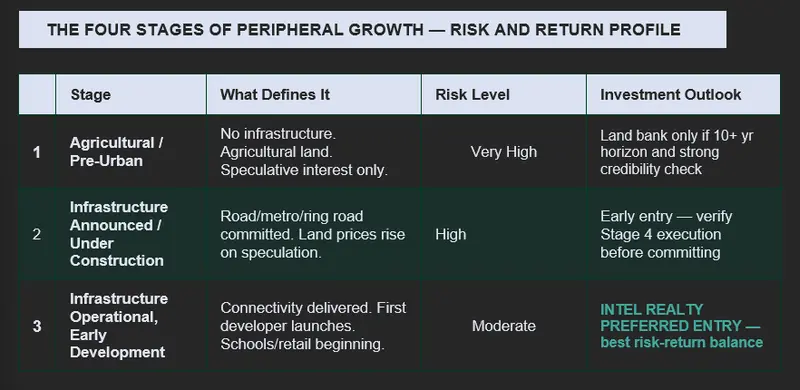
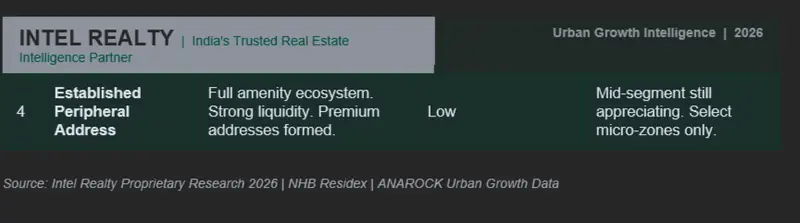
The Four Stages of Peripheral Growth — and When to Invest
Peripheral growth follows a recognisable four-stage cycle. Each stage carries different investment risk and different remaining appreciation potential. Correctly identifying the stage your target zone occupies is the most important analytical task for any peripheral real estate investment decision.
What Separates High-Quality Peripheral Growth from Failed Suburban Sprawl
Not every peripheral zone delivers on its promise. India has examples of peripheral zones that appreciated dramatically and those that stagnated for a decade. The difference comes down to a specific set of conditions — all of which are verifiable before you invest.
CONDITIONS FOR SUCCESSFUL PERIPHERAL GROWTH
High-quality road connectivity with expressway or ring road access
Metro extension or suburban rail within planned horizon
Employment decentralisation — IT park, SEZ, or major campus nearby
Master-planned township development by credible developers
Education and healthcare infrastructure arriving or planned
State government proactive sector development plan approval
Zones meeting 5+ conditions consistently deliver Stage 3 to 4 appreciation.
CONDITIONS FOR PERIPHERAL ZONE FAILURE
Single-road access — no redundancy if road becomes congested
No employment within commutable distance — 100% city-dependent
Missing utilities — water, power, sewage not committed
Fragmented ownership — no large developer anchoring the zone
No sector development plan approval — legal ambiguity on land use
Schools, hospitals, and retail entirely absent with no announced plans
Peripheral zones meeting 3 or more failure conditions typically stagnate for 5 to 10 years regardless of proximity to the city.
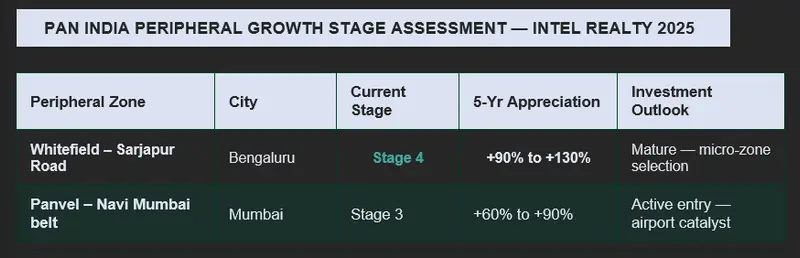
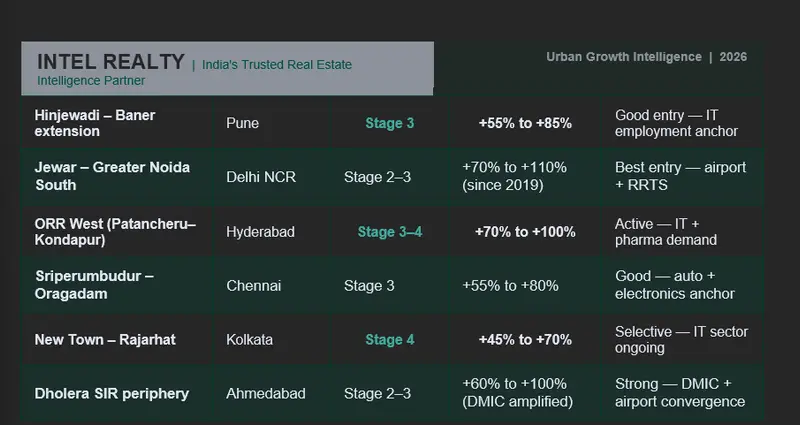
Peripheral Growth Zones Across India —
Peripheral growth is unfolding at different stages across India's major cities. Here is Intel Realty's current classification of the most significant peripheral zones nationally.
3 Case Studies: Peripheral Growth Creating Real Estate Wealth Across India
01 Whitefield, Bengaluru — From Peripheral Village to Premium Tech Suburb
CLIENT VOICE
I bought a flat in Whitefield in 2008. Everyone said the roads were terrible and it was not worth the commute. I paid Rs. 2,800 per sq.ft. Today the same property is quoted at Rs. 9,200. The roads improved. The metro is coming. The IT campuses never left. — Long-term Investor, Bengaluru
Whitefield's transformation from a peripheral agricultural belt into one of Bengaluru's most valued tech suburb addresses is one of India's most studied peripheral growth stories. In the early 2000s, Whitefield was a semi-rural periphery approximately 18 km from central Bengaluru — chosen by IT companies for its large, affordable land parcels when central Bengaluru had already become congested and expensive. The initial IT campus clusters created employment decentralisation — and residential demand followed.
The Whitefield peripheral growth cycle progressed through all four stages over two decades. Stage 1 (agricultural land with speculative interest) gave way to Stage 2 (IT campus development and basic road improvement) from 2000 to 2008. Stage 3 (master-planned residential townships, school infrastructure, organised retail) built through 2008 to 2018. Stage 4 (established premium address with high liquidity and premium pricing) has characterised the zone since 2018 — with further appreciation driven by the Bengaluru Metro Phase 2 extension reaching Whitefield in 2024. Investors who entered in Stage 2 and 3 have achieved returns of 250 to 400% over their holding period.
KEY TAKEAWAYEmployment decentralisation is the most durable driver of peripheral residential demand. When IT parks, campuses, and commercial offices locate in a peripheral zone, they create self-sustaining residential demand that is independent of city-centre commuting — and this demand compounds across multiple decades.
02 New Town Rajarhat, Kolkata — Planned Peripheral City in East India
CLIENT VOICE
"Kolkata was slow to develop its periphery compared to Bengaluru or Hyderabad. But New Town was a genuine planned city — not an ad-hoc township. I entered in 2012 at Rs. 2,200 per sq.ft based on the IT sector land allocation data I was tracking. By 2022, my flat was at Rs. 4,800 — and it is still appreciating." — Residential Investor, Kolkata
New Town Rajarhat is Kolkata's most ambitious planned peripheral development — a master-planned urban extension approximately 20 km from central Kolkata, developed on what was previously agricultural lowland in the North 24 Parganas district. The West Bengal government, through HIDCO (Housing Infrastructure Development Corporation), planned New Town as a fully serviced new township with sector-wise development including IT park zones, residential sectors, commercial districts, and a convention centre.
What makes New Town significant for peripheral growth analysis is the role of government planning in creating infrastructure credibility. Unlike organically developed peripheries where infrastructure arrives reactively, New Town's infrastructure — roads, piped water, sewage, power — was built before significant private residential development began. This credibility attracted Infosys, Wipro, and several other IT anchors to the dedicated IT sector zone, creating employment that bootstrapped residential demand. Appreciation has been steady rather than spectacular — averaging 7 to 9% annually since 2012 — but highly durable, driven by genuine end-user demand rather than speculative cycles.
03Hinjewadi, Pune — IT Park Peripheral Growth at Its Most Textbook
CLIENT VOICE
"Hinjewadi was just a phase 1 IT park in 2005 with terrible road access. My colleagues laughed when I bought there. By 2015, Phases 2 and 3 were operational, the expressway was being improved, and every IT company in Pune was shifting campuses there. My flat had tripled. The peripheral growth thesis worked exactly as expected." — IT Professional Investor, Pune
Hinjewadi's development as Pune's primary IT peripheral zone provides one of India's most textbook examples of employment-led peripheral growth. The Rajiv Gandhi Infotech Park in Hinjewadi — developed in phases from the late 1990s onwards — attracted Infosys, Wipro, Tech Mahindra, Cognizant, and over 100 other IT companies to a peripheral zone that in 1995 was primarily agricultural land 18 km from central Pune.
The peripheral growth cycle at Hinjewadi accelerated as each new IT park phase opened: Phase 1 attracted early buyers; Phase 2 opened the zone to mid-market residential developers; Phase 3 established Hinjewadi as a self-contained professional suburb with schools, hospitals, retail, and hospitality. The Pune Metropolitan Region Development Authority's planned metro connection — with construction underway — represents the secondary infrastructure trigger that will drive the next appreciation phase for a zone now entering a mature Stage 3 to 4 transition. Investors who entered between 2005 and 2012 have seen appreciation of 200 to 350%.
How to Identify the Next High-Quality Peripheral Zone Before It Appreciates
The signals that identify a high-quality peripheral zone in its early stages are all public. Here is Intel Realty's step-by-step identification process:
Check infrastructure commitment: Has a metro extension, expressway, or ring road been approved and funded for this zone? Verify from official DMRC, NHAI, or state PWD sources — not from developer marketing.
Look for employment anchors: Are IT parks, SEZs, or industrial estates being developed in or adjacent to the peripheral zone? Check state investment promotion authority approvals and company announcements.
Assess land pricing vs city centre: A peripheral zone priced at 30 to 50% of comparable city-centre properties has meaningful first-mover appreciation potential. A zone already priced at 70%+ of city-centre rates has limited peripheral discount remaining.
Track developer entry: When two or more credible developers launch master-planned projects in a peripheral zone within the same 24-month window, it signals institutional recognition of the growth thesis — typically 3 to 5 years before mainstream retail buyers discover the area.
Verify utility infrastructure: Confirm that piped water supply, power grid connectivity, and sewage treatment are either operational or have committed state government delivery timelines. Peripheral zones without committed utilities cannot sustain mid-market residential occupation.
Assess the sector development plan: State urban development authorities issue sector development plans that designate land use, FAR, and infrastructure requirements. A zone with an approved sector plan has resolved the legal ambiguity that keeps institutional developers from committing capital.
INTEL REALTY PRINCIPLE
The best peripheral zone investments are made when the growth thesis is visible to professionals tracking data — infrastructure under construction, employment anchors acquiring land, developers filing RERA applications — but before the zone becomes a topic of mainstream real estate media coverage. That window, typically 3 to 5 years wide, is where the highest-return peripheral investments are made.
FREQUENTLY ASKED QUESTIONS
FAQ: Peripheral Growth and Real Estate Investment in India
Q1—What is peripheral growth in the context of Indian real estate?
Peripheral growth refers to the outward expansion of cities into zones that were previously agricultural, peri-urban, or semi-rural. In Indian real estate, it describes the process by which city edges — initially valued at a significant discount to city-centre properties — gradually develop the infrastructure, employment access, and amenity ecosystem that makes them self-sustaining residential and commercial addresses. This process is driven by affordability pressure pushing buyers outward, infrastructure investment enabling connectivity, employment decentralisation making peripheral living viable, and developer supply response creating community amenity. Intel Realty tracks peripheral growth as the defining real estate investment theme of the decade — because India's 480 million expected urban migrants by 2050 cannot fit into existing city cores.
Q2—Which Indian cities have the best peripheral real estate investment opportunities in 2026
Based on Intel Realty's 2025 stage assessment, the strongest current entry opportunities are: Jewar-Greater Noida South corridor (NCR) — Stage 2 to 3, airport + RRTS convergence; Panvel-Navi Mumbai belt — Stage 3, pre-airport commissioning window; Hinjewadi extension-Baner (Pune) — Stage 3, IT employment anchor, metro under construction; and the Dholera SIR periphery (Ahmedabad) — Stage 2 to 3 with DMIC amplification. Whitefield (Bengaluru) and New Town Rajarhat (Kolkata) are Stage 4 — recommended only for micro-zone commercial or select residential with specific employment anchors.
Q3—What is the optimal peripheral investment radius around Indian metros?
Based on Intel Realty's pan-India research, the optimal peripheral investment radius varies by city size and infrastructure quality. For the four largest metros — Mumbai, Delhi NCR, Bengaluru, and Hyderabad — the optimal residential investment radius in 2025 is 15 to 30 km from the city centre, in zones with expressway or metro connectivity reducing effective commute time below 45 minutes. For tier-2 cities like Pune, Ahmedabad, and Chennai, the optimal radius is 10 to 20 km. Beyond these ranges, effective commute time exceeds the threshold at which the city's employment market can realistically sustain daily residential demand without local employment decentralisation to compensate.
Q4—How do I distinguish a high-quality peripheral zone from one that will stagnate?
Apply the six-condition checklist: high-quality road connectivity, metro or suburban rail within planned horizon, employment decentralisation anchor nearby, master-planned development by credible developers, education and healthcare infrastructure arriving, and state sector development plan approval. Zones meeting five or more conditions consistently deliver Stage 3 to 4 appreciation of 2 to 4 times the city-centre benchmark. Zones meeting two or fewer conditions — regardless of how aggressively developers market them — typically stagnate for 5 to 10 years while the missing conditions are resolved. The most common mistake is treating developer presence alone as a sufficient indicator of peripheral zone quality.
Q5—How does Intel Realty identify peripheral growth zones before the market does?
Intel Realty tracks peripheral zones through four data streams: official infrastructure approval and construction progress monitoring (metro, expressway, ring road), state investment authority employment anchor announcements (IT parks, SEZs, industrial estates), developer RERA application filings in peripheral zones (a leading indicator of institutional zone recognition 2 to 3 years before launch marketing), and municipal corporation sector development plan approvals. When infrastructure is at Stage 3 execution, an employment anchor has committed, and two or more credible developers have filed RERA applications — but before the zone appears in mainstream media as an investment story — Intel Realty classifies it as a high-priority peripheral entry opportunity for clients.