Property Verification Checklist: Everything to Check Before Buying a Flat in Gurgaon or Delhi (2026)
Property Verification Checklist: Everything to Check Before Buying a Flat in Gurgaon or Delhi (2026)
Nearly 35% of real estate disputes in India happen because of missing paperwork or unclear ownership. That's as taggering number — and almost all of these disputes were preventable. Buyers who skipped due diligence paid the price with years of legal battles, frozen investments, and lost money. This checklist is your protection. Work through every section before you pay even a booking amount. The few hours you invest today can save you years of trouble tomorrow.
Section 1: RERA Verification — Your Most Important First Step
Under the Real Estate (Regulation and Development) Act, 2016, all residential projects above 500sq metres or 8units must be registered with the state RERA authority. In Gurgaon, this means Haryana RERA (hrera.org.in). This is non-negotiable.
How to Verify RERA in Gurgaon (Step by Step):
• Visit hrera.org.in and search by project name, builder name, or registration number
• Confirm status is 'Active' or 'Registered' — not 'Lapsed' or 'Under Review'
• Check the committed possession date on the portal
• Review Quarterly Progress Reports (QPR) — physical progress must match financial withdrawals
• Verify escrow account balance — 70% of buyer funds must be in project-specific escrow
• Check for recovery warrants or complaints filed against the builder
• Compare the builder's past projects — were they delivered on time or delayed?
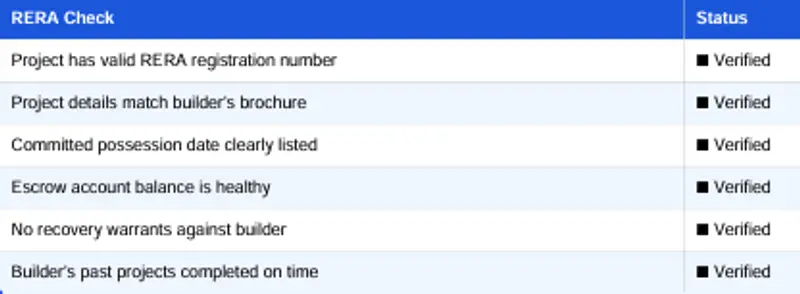
■ Red Flag: 'Pre-launch' or 'RERA registration in process' — do NOT pay any amount. Every project above 500 sqm must be registered BEFORE taking bookings
Section 2: Legal Documents You Must Check
Title Deed / Sale Deed
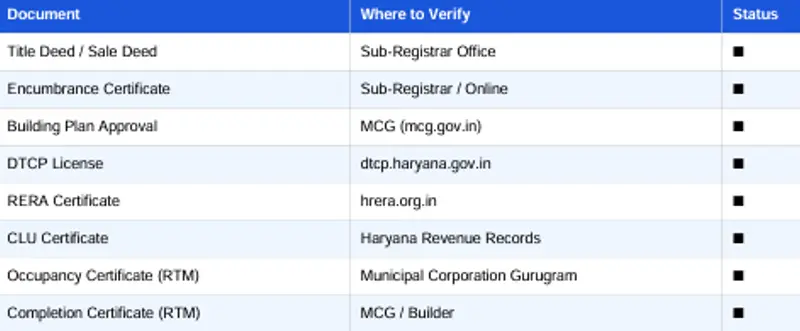
The most fundamental document — proves who legally owns the property. For new projects, confirms the builder has clear title to the land. For resale, verify the complete chain of ownership. Get this verified at the Sub-Registrar's office and by a property lawyer.
Encumbrance Certificate (EC)
Confirms the property has no existing loans, mortgages, liens, or legal disputes. Request the EC from the Sub-Registrar covering at least 12–15 years. Any loan entries must be formally cleared before purchase.
Building Plan Approval
Confirms the construction is legally sanctioned by the Municipal Corporation of Gurugram (MCG). Any floor, terrace, parking area, or amenity must be specifically approved. Unauthorised construction can be demolished — and this affects resale value too.
Occupancy Certificate (OC) — For Ready Flats Only
The OC confirms the building is constructed as per approved plans and is legally fit for occupation. Without OC:GST of 5% applies, banks may refuse home loans, and utility connections can be denied. Always ask for and verify the OC from MCG directly — not just from the builder.
Other Key Documents
• DTCP License from Haryana government (for private colonies) — verify at dtcp.haryana.gov.in
• CLU (Change of Land Use) Certificate if land was originally agricultural
• Environmental Clearance for large projects (from Ministry of Environment & Forests)
• NOC from relevant authorities — fire department, electricity board, water authority
Section 3: Builder & Project Health Checks
• Check HRERA profile: How many past projects? Delivered on time or delayed?
• Google builder name + 'complaints / NCDRC / delay' — look for patterns, not isolated reviews
• Visit a completed project and talk to actual residents — most reliable feedback you'll get
• Check for active litigations in consumer courts or NCLT
• Verify escrow account compliance: QPR must show physical progress matching fund withdrawals
■■ If the HRERA portal shows recovery warrants issued against the builder or very low escrow balance relative to construction progress — walk away. No negotiated price discount is worth this risk.
Section 4: Financial Verification — No Hidden Costs
Always get a written all-inclusive cost sheet. Here's what to verify
:• Base price: Is it quoted on carpet area or super built-up area? (Significant difference)
• GST applicability: 0% for RTM with OC, 5% for UC. Confirm in writing.
• PLC charges: Corner, park-facing, higher-floor premiums — ask for detailed breakup
• Parking: Location of your specific slot, covered or open, number of slots
• Club membership: What's included, is it mandatory, recurring or one-time?
• Infrastructure charges (IDC/EDC): Government levied, passed to buyer — verify amount
• Maintenance GST: 18% GST if monthly maintenance exceeds ■7,500
Section 5: Physical Inspection Checklist
For Under-Construction Project:
• Visit the actual construction site — not just the sales office and model flat
• Is construction progressing? Compare site progress with HRERA's QPR reports
• Sufficient workers on site? A slow or empty site signals financial problems
• Are promised amenities (clubhouse, pool, landscaping) visible in construction?
• Check surroundings: What is being built adjacent to the project? For Ready-to-Move Properties:
• Visit the actual unit (not model flat) — check flooring, walls, plumbing, electrican
l• Test all taps, switches, geysers, and electrical outlets — bring a phone charger
• Check for water seepage marks on ceilings and walls (very common in Gurgaon
)• Verify water supply: 24/7 or time-based? Adequate pressure on your floor?
• Power backup: Does DG cover all areas including lifts and common spaces?
• Talk to existing residents — ask about real maintenance costs and society management• Verify parking slot location — must be accessible and in the same wing as your flat
Section 6: Builder-Buyer Agreement (BBA) — Read Every Line
• All promised amenities must be listed with specific handover dates (mandatory under RERA
)• Possession date must be clearly stated — RERA compensation kicks in if violated
• Penalty for delay: Builder must pay MCLR+2% interest for every delayed month
• Cancellation and refund terms — understand what you get back if you exit
• Area definition: Carpet area vs super built-up area must be explicitly stated
• Force majeure clauses: What events allow delay without penalty — check scope
■■ Legal Tip: Never sign the BBA without reading it fully or having a property lawyer review it. A ■20,000–50,000lawyer fee protects crores in investment. Verbal promises mean nothing — if it's not in the agreement, it doesn't legally exist.
Frequently asked Questions
Q: How do I verify an Occupancy Certificate is genuine?
Visit the MCG (Municipal Corporation of Gurugram) office directly or check their online portal. Ask the builder for the OC document and cross-verify the project name, address, and certificate number with MCG records. Don'tIntelRealty.in | Delhi & Gurgaon Real Estate | 2026 -2027Page 15just accept a scanned copy from the builder — verify independently.
Q: Is it necessary to hire a property lawyer for verification?
Strongly recommended. A property lawyer charges ■20,000–50,000 to verify all documents and flag issues. Given that you're investing ■50 lakh to ■5 crore, this cost is trivial. Many legal disputes that reach courts could have been avoided with a simple pre-purchase verification.
Q: What should NRI buyers specifically check?
NRIs should additionally verify FEMA compliance for fund transfer (use NRE/NRO accounts), ensure Special PoA (not General PoA) is registered for the representative handling the purchase, and confirm TDS implications when buying from a resident Indian seller (20% TDS applies).
Master Verification Checklist
✓ RERA: Registration number, escrow status, delivery date, past complaints
✓ Legal Title: Title deed, EC (12–15 years), chain of ownership, no disputes
Approvals: Building plan sanction, CLU, DTCP license, environmental clearance
✓ Ready Property: OC from MCG, CC, utility connections active and working
✓ Builder Track: Past delivery record, HRERA history, litigation check online
✓ Financial: All-inclusive cost sheet, GST, stamp duty, ALL hidden charges
✓ Physical: Actual unit visit (not model flat), water, power, seepage check
✓ Agreement: BBA review, all amenities with dates, penalty clauses, possession date
✓ Registration: Sub-registrar, stamp duty payment, mutation post-registration