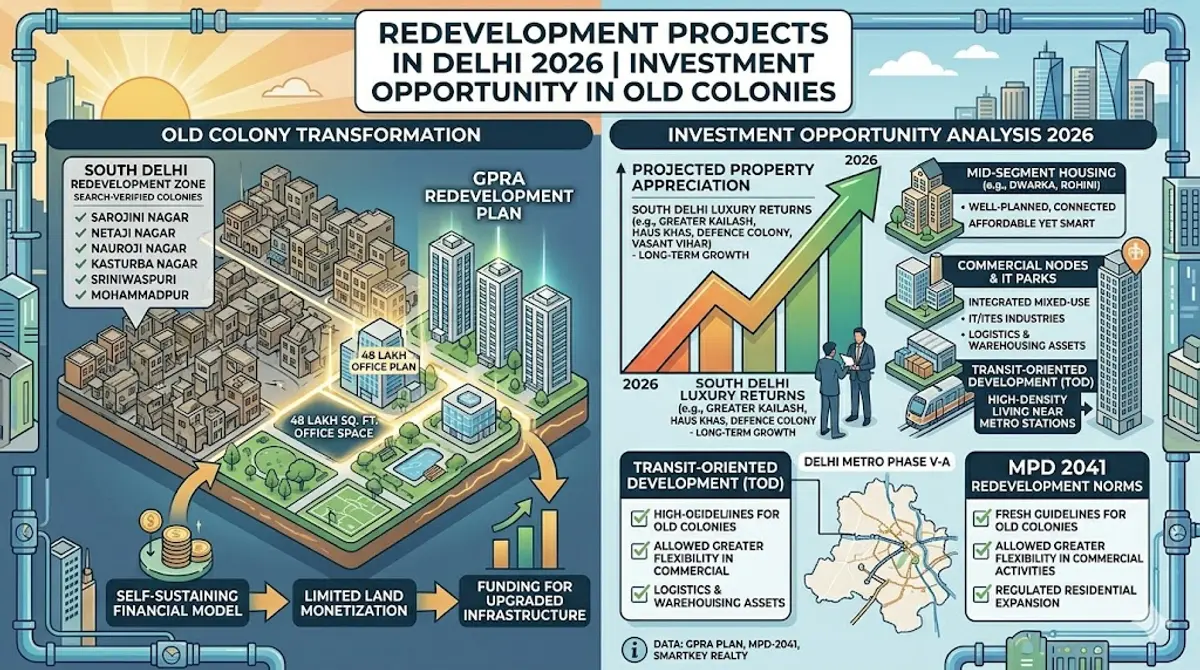
Redevelopment Projects in Delhi 2026 | Investment Opportunity in Old Colonies
Redevelopment Projects in Delhi 2026 | Investment Opportunity in Old Colonies
Delhi's Redevelopment Story — A Multi-Crore Opportunity
Delhi's housing stock is aging. Large swathes of the city's residential areas — built in the 1960s–80s — have buildings approaching or exceeding their structural design life. Redevelopment of these properties, whether through DDA schemes, private society agreements, or individual bungalow rebuilding, creates significant investment opportunities for buyers who can navigate the complexity involved.
DDA Cluster Redevelopment Scheme
DDA's Cluster Redevelopment Scheme targets ageing multi-storey housing colonies where individual flats can be pooled for comprehensive redevelopment. Under the scheme, existing flat owners receive new, modern apartments (typically larger) in the redeveloped complex plus cash compensation for relocation, funded by the developer who gains rights to develop additional floors for sale.
Targeted colonies include older DDA flats in Saket, Alaknanda, Kalkaji, and Dwarka where aging structures make redevelopment economically viable. The process is complex — requiring 75%+ owner consensus and DDA approval — but the investment case for early buyers of redevelopment-eligible DDA flats can be compelling.
Private Society Redevelopment
Private residential societies built in the 1970s–90s can initiate redevelopment by forming RWA-backed committees and engaging developers. In south Delhi localities like Greater Kailash and Malviya Nagar, several society redevelopments have delivered premium new apartments to existing owners at zero cost — funded by the sale of additional units to new buyers.
For investors, purchasing units in societies that are at the early stages of redevelopment consideration — at existing old-construction prices — can generate 40–80% appreciation when redevelopment delivers new units.
Individual Bungalow Redevelopment
The most common form of Delhi redevelopment is individual bungalow owners demolishing and rebuilding as multi-floor builder developments. This is a mature market in south Delhi — building contractors, architects, and buyers are all experienced participants.
Buyers of newly rebuilt builder floors in south Delhi benefit from new construction quality at established location prices — a significant advantage over purchasing in fully new areas without the same infrastructure and community character.
Risks and Considerations
Redevelopment timelines are highly variable — legal disputes among co-owners, approval delays, and contractor issues can extend projects by years. Investing in redevelopment-eligible properties requires patience and risk tolerance.
Always verify the ownership consensus status, DDA approval stage, and developer financial capacity before paying any premium for redevelopment potential.
Conclusion
Redevelopment investment in Delhi is a specialist strategy with significant upside for informed investors. DDA cluster schemes, private society redevelopments, and individual bungalow rebuilds each offer distinct risk-return profiles. The key is identifying the right stage of the redevelopment cycle to invest — early enough for maximum upside, but with sufficient proof of viability to avoid pure speculation.
Frequently Asked Questions (FAQs)
Q: How does DDA's cluster redevelopment scheme work for flat owners?
A: Existing owners pool their flats with DDA and a private developer. The developer rebuilds the complex with modern apartments — existing owners receive new, larger apartments at no cost. Additional units built for sale finance the development. Owner consensus of 75%+ is typically required.
Q: How can I identify redevelopment-eligible societies in south Delhi?
A: Look for: DDA societies built pre-1990 with aging structures, societies where RWAs have discussed redevelopment in public meetings, localities where adjacent societies have already undergone redevelopment (proving feasibility), and buildings approaching or exceeding 40 years of age.
Q: What is the typical appreciation from buying in a pre-redevelopment society?
A: Returns vary enormously — from 30–50% if redevelopment completes in 3–5 years to negative returns if the project stalls. Success depends entirely on owner consensus achievement and developer execution. Risk is higher than standard property investment.
Q: Can I get a home loan to buy in a redevelopment project?
A: Home loans for under-redevelopment properties are complex — most banks require existing title clarity and redevelopment agreement before lending. Consult specialist lawyers and bank credit teams familiar with DDA redevelopment formats before assuming financing is straightforward.