Why Some Highways Fail Real Estate Investors
WHY SOME HIGHWAYS FAIL INVESTORS
Why Some Highways Fail Real Estate Investors: The Six Hidden Traps Across India
Highway infrastructure and real estate returns are deeply linked in the popular imagination of Indian investors. A new NHAI expressway is announced, property prices in the surrounding area spike, developers launch projects, and buyers rush in — convinced that connectivity equals appreciation.
But the data tells a more complicated story. Not every highway corridor delivers on its real estate promise. Some corridors see prices stagnate for a decade after commissioning. Others see speculative spikes that correct sharply and never recover. And some highways — despite being operational, well-maintained, and well-trafficked — simply fail to trigger the demand ecosystem that drives sustained property appreciation.
At Intel Realty, we have tracked highway corridor performance across India since 2005. We have seen the successes — Hyderabad's ORR, the Mumbai-Pune Expressway, the Yamuna Expressway. But we have also studied the failures and near-failures with equal rigour. This guide identifies the six hidden reasons why some highway corridors consistently disappoint real estate investors — and gives you the framework to avoid every one of them.
INTEL REALTY RESEARCH
Across 28 major highway corridors studied between 2000 and 2024, approximately 40% underperformed the regional market appreciation benchmark over a 10-year hold period. In every case, at least three of the six failure factors were present before investment entry. None were hidden — all were detectable with basic due diligence.
The Six Reasons Highway Corridors Fail Real Estate Investors
Understanding these six failure factors is the single most important risk-management tool available to any highway-corridor property investor in India. Each factor is independently capable of destroying returns. When two or more are present, underperformance is almost certain.
01
REASON
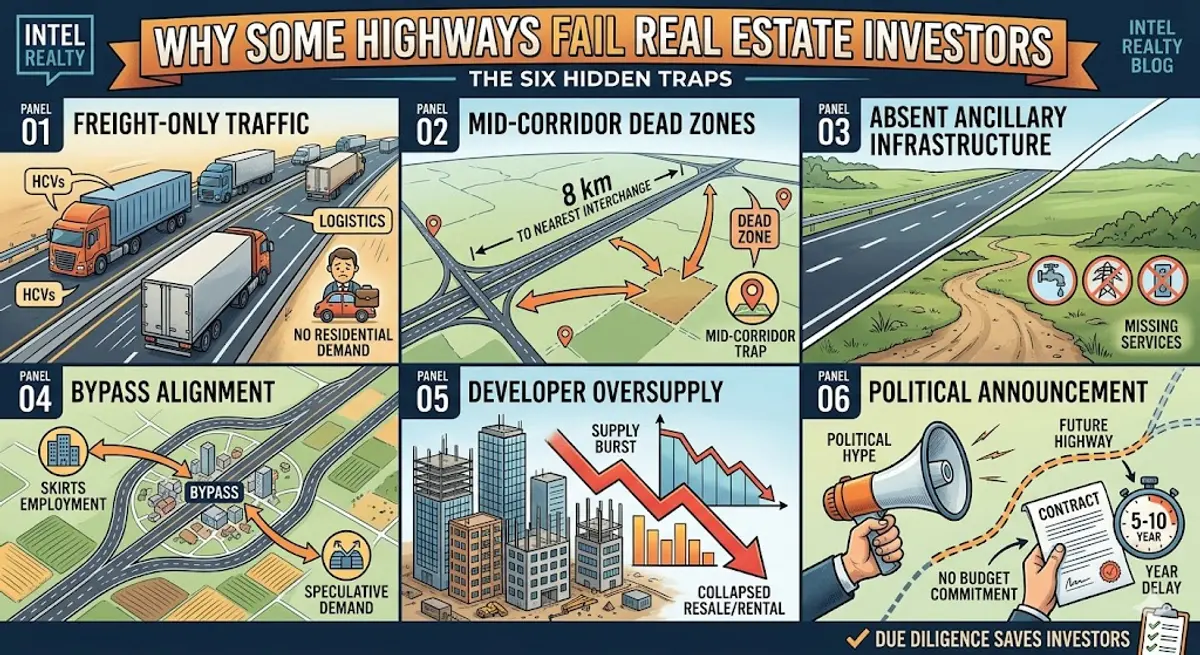
Freight-Only Traffic Profile — No Residential Demand Generator
A highway built primarily for inter-city freight movement serves trucks, not commuters. Without a commuter traffic profile, the corridor generates no residential demand in adjacent zones. Investors who confuse logistics efficiency with liveability consistently overpay for land near freight-dominant highways. High truck volume is not a proxy for residential demand — it is often inversely correlated, as noise and pollution suppress liveability.
02
REASON
No Interchange Within 5 km — Mid-Corridor Dead Zones
High-speed highways are accessible only at interchange points. Land parcels more than 5 km from the nearest interchange cannot efficiently access the highway and therefore derive minimal benefit from it. Mid-corridor locations feel close on a map but are functionally disconnected from the highway's economic catchment. Developers exploit this geographic illusion in their marketing. Buyers pay highway premiums for locations that capture no highway benefit.
03
REASON
Absent Ancillary Infrastructure — Water, Power, Roads Missing
A highway corridor without committed water supply, reliable power infrastructure, and connecting internal roads cannot support residential habitation or industrial operation at scale. Thousands of highway-adjacent projects across India sit vacant or underoccupied because the highway was built but the basic services never followed. State government commitment to ancillary infrastructure is the single strongest predictor of whether highway adjacency translates into property value — and the most commonly overlooked factor in buyer due diligence.
04
REASON
Bypass Alignment — Skirts City Instead of Connecting Employment Centres
A bypass highway is designed to route through-traffic around a city — not to improve accessibility within it. Bypass alignments typically run through agricultural or industrial periphery with no employment concentration along the route. Residential demand near a bypass is speculative at best because workers, commuters, and professionals have no employment destination reachable from the bypass without re-entering congested city roads. Employment adjacency — not just road adjacency — is what drives sustainable residential demand.
05
REASON
Developer Oversupply Ahead of Real Demand
High-profile highway announcements trigger simultaneous developer launches that often flood corridors with supply years before genuine residential demand materialises. When supply overwhelms nascent demand, prices stagnate or correct. Investors who enter launch-stage projects in corridor with oversupply absorb years of capital lockup without appreciation. The irony is that the most aggressively marketed corridors — with the most developer launches at announcement stage — are also the most likely to be oversupplied relative to actual demand.
06
REASON
Political or Pre-Election Announcement Without Budget Commitment
As established in Intel Realty's infrastructure analysis series, pre-election highway announcements frequently lack committed funding, approved DPRs, and realistic land acquisition timelines. Investors who enter on the announcement absorb 5 to 10 years of execution uncertainty. In many cases, the project is eventually cancelled, significantly scaled back, or routed differently from the original announcement — leaving investors with assets that appreciated on false connectivity expectations.
How to Distinguish a Winning Highway from a Failing One Before You Invest
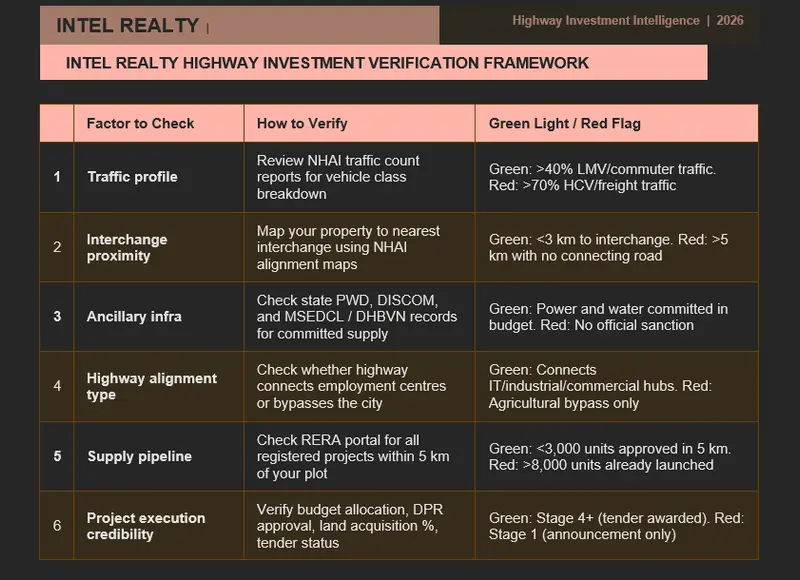
The good news is that none of the six failure factors are invisible. Each can be identified before investment commitment through basic due diligence and intelligent observation. Here is the Intel Realty pre-investment verification framework for highway corridors.
3 Case Studies: When Highway Corridors Failed and What We Learned
01 The Freight Bypass Trap — Eastern Peripheral Expressway, NCR
CLIENT VOICE
"My broker showed me a map with the Eastern Peripheral Expressway highlighted. He called it the next big corridor. I bought a flat at a project that marketed highway proximity heavily. Five years later, the highway is operational and well-maintained — but it carries trucks, not commuters. My flat is worth almost exactly what I paid." — Residential Buyer, NCR
The Eastern Peripheral Expressway (Kundli-Manesar-Palwal) was announced as a major infrastructure achievement — and it is, for freight movement. The 135 km highway efficiently routes trucks and heavy commercial vehicles around Delhi, relieving city-centre congestion. For freight logistics, the EPE is a success. For residential real estate investment, several sections have dramatically underperformed expectations.
The reason is the freight-dominant traffic profile. The EPE's primary users are HCV trucks, not commuters. Without commuter traffic, there is no employment accessibility for residents — and without employment accessibility, residential demand is speculative rather than fundamental. Projects marketed as 'EPE-adjacent' in mid-corridor locations without interchange proximity saw launch prices that were not validated by genuine demand, leading to stagnation or correction in resale markets. Investors who checked NHAI traffic count data before entry would have identified the freight-heavy profile and adjusted their return expectations accordingly.
KEY TAKEAWAYA highway's success as freight infrastructure does not translate into residential real estate returns. Always verify traffic composition before assuming a highway corridor will drive residential demand.
02 The Oversupply Collapse — Yamuna Expressway Mid-Corridor
CLIENT VOICE
"The Yamuna Expressway announcement brought 15 developer launches in one year. I was the 12th buyer in my project. By the time possession came, there were 8,000 units looking for tenants in a 3 km radius. My rental yield was 1.8%. That is not an investment — that is a savings account with a lot more paperwork." — Apartment Investor, Greater Noida
The Yamuna Expressway is a genuine infrastructure success story — and also a cautionary tale about what happens when developer supply vastly outpaces real demand. While the expressway did transform connectivity between Greater Noida and Agra, it also triggered one of India's most aggressive corridor-launch cycles. Dozens of developers launched high-rise projects simultaneously, creating an inventory overhang that persisted for nearly a decade.
Mid-corridor zones — particularly between the Jewar and Tappal interchanges — saw the worst oversupply dynamics. Projects were launched on speculative demand from investors rather than genuine end-user absorption. Rental yields collapsed to 1.5 to 2% as supply swamped demand. Capital appreciation was near-zero for investors who entered between 2012 and 2016, despite the expressway's genuine operational success. The lesson is counterintuitive: the most enthusiastically marketed highway corridors attract the most developer supply — and oversupply is one of the most reliable destroyers of short-to-medium term returns.
KEY TAKEAWAYDeveloper enthusiasm for a corridor is a warning sign, not a validation. Always check the total approved and under-construction supply pipeline before entering any highway-adjacent market.
03 The Ancillary Infrastructure Failure — A State Highway Corridor, Central India
CLIENT VOICE
"I bought a plot near a newly commissioned state highway in Madhya Pradesh based on a developer's promise that it was 'the next Pune-Mumbai corridor.' Six years later, there is no piped water, no reliable power, and the connecting road to the highway is a mud track that floods every monsoon. The highway itself is fine. Everything else failed." — Plot Investor, Madhya Pradesh
This case — representative of dozens of similar situations across central and eastern India — illustrates the ancillary infrastructure failure trap with painful clarity. The state highway in question was completed on schedule and is operational. But the land along its alignment remains largely undeveloped because the state government committed to ancillary infrastructure that never arrived: connecting internal roads were not built, piped water supply was sanctioned but not funded, and power infrastructure was limited to agricultural connections inadequate for residential development.
The developer who marketed the plots cited the highway as the primary value driver — which was technically accurate for the highway itself, but irrelevant without the supporting infrastructure that makes residential and commercial occupation feasible. Buyers paid highway-adjacency premiums for land that has not appreciated meaningfully in six years. The plots are not worthless — but they require another 5 to 8 years of ancillary infrastructure delivery before they will support the price levels that were implied at the time of purchase.
KEY TAKEAWAYHighway adjacency without ancillary infrastructure is exposure without a catalyst. Verify water, power, and connecting road commitments from state government records before paying any infrastructure premium.
The Due Diligence Checklist Every Highway Investor Needs
The six failure factors are predictable and preventable. Here is the complete Intel Realty due diligence process for every highway-linked property decision:
BEFORE YOU VISIT THE SITE
Download NHAI traffic count data for the specific highway section
Map the nearest interchange and measure true road distance — not straight line
Check state RERA portal for total approved supply within 5 km
Verify project execution stage (Stage 4+ only for credible entry)
Check whether highway alignment connects employment centres or bypasses them
ON SITE AND IN RECORDS
Visit the site at peak hour — observe actual vehicle types and volumes
Check state PWD records for connecting internal road commitments
Verify power supply capacity from local DISCOM/MSEDCL office
Confirm piped water supply commitment from municipal authority
Walk the route from the plot to the nearest employer — is it viable without a car?
INTEL REALTY COMMITMENT
We complete all 10 of these due diligence steps — plus a 12-point RERA and legal title check — on every highway-corridor property we recommend to clients. Our clients do not pay for proximity. They pay for genuine, verified, infrastructure-backed property value.
FREQUENTLY ASKED QUESTIONS
FAQ: Why Some Highways Fail Real Estate Investors in India
Q1—Why do some highway corridors fail to deliver property appreciation in India?
Highway corridors fail to deliver property appreciation when one or more of six core conditions are absent: commuter-relevant traffic profile, interchange proximity, ancillary infrastructure, employment adjacency, managed supply pipeline, and credible project execution. Intel Realty's research of 28 major corridors between 2000 and 2024 found that approximately 40% underperformed the regional benchmark — and in every underperforming case, at least three failure factors were present before investment entry. None required specialist knowledge to detect — all were identifiable through basic due diligence on publicly available data.
Q2—How do I tell whether a highway will drive residential demand or just freight?
Check the NHAI traffic count data for the specific highway section, which is publicly available in periodic traffic census reports. A highway where light motor vehicles and passenger vehicles represent more than 40% of traffic has commuter relevance. A highway where heavy commercial vehicles dominate at 70% or more is primarily a freight corridor and is unlikely to drive residential demand in adjacent zones. Visiting the highway at peak commute hours — 8 to 9 AM and 6 to 7 PM — and observing vehicle types directly is the fastest and most reliable verification method.
Q3—What is the most common mistake buyers make when investing in highway-adjacent property?
The most common mistake is conflating map proximity with functional accessibility. A plot 1 km from a high-speed expressway looks extremely well-connected on a developer's site plan — but if the nearest interchange is 8 km away, the property has no meaningful highway access. Residents would still depend entirely on state roads to reach their destinations. The second most common mistake is entering at announcement stage when supply is low but execution risk is high, only to find that by the time the highway delivers, a supply surge has eliminated the appreciation potential. Interchange-proximity verification and RERA supply-pipeline checking eliminate both mistakes.
Q4—Can a highway corridor recover after initial underperformance?
Yes — but recovery typically requires a secondary catalyst rather than the highway itself. The Yamuna Expressway mid-corridor, which underperformed significantly between 2012 and 2019, began recovering after the Jewar International Airport announcement in 2019 provided a new demand catalyst. Similarly, highway corridors with initial ancillary infrastructure gaps have recovered when subsequent state government investment delivered water, power, and connecting roads. The recovery timeline in these cases is typically 7 to 12 years from initial investment — meaning the opportunity cost of early entry is very high compared to waiting for secondary catalyst confirmation.
Q5—How does Intel Realty evaluate highway investment opportunities to avoid these failures?
Intel Realty applies a six-factor failure risk matrix to every highway corridor before making any investment recommendation. We verify traffic profile from NHAI census data, map interchange proximity from official alignment documents, check ancillary infrastructure commitments from state PWD and utility records, confirm employment adjacency from commercial occupier data, assess the RERA supply pipeline within 5 km, and verify project execution stage against our five-stage credibility framework. A corridor must score Green on at least four of six factors to advance to our recommended list. This process, applied consistently since 2010, has allowed Intel Realty clients to avoid every major highway investment failure we have subsequently studied.